Well, I had plans for 2024, but you know how that goes. A stressful combination of circumstances early in the year meant that anything that wasn’t a necessity had to be put aside. Blogging was definitely not a priority. So 2024 will get a round-up post, and hopefully I’ll start afresh in 2025.
So, what’s new? In terms of the online me, I joined Bluesky in February. I said in my first post that I wasn’t sure about returning to social media after more than five years without it, especially in a year with so many elections. As a platform, it has its good points (shout out to the gardening feed), but I deactivated my account a few days before Christmas, which tells its own story. Each to their own – and I hope that the core community on there manage to stick together – but I’m confident that I’ve made the right decision for me.
In terms of offline me (although this is actually online activity as well), I had to put my French lessons to one side in the first half of the year, but I picked it back up in September, and will be continuing with it next year. When I learnt Spanish, it was through in-person conversation classes, so finding an online equivalent has been a bit of a Goldilocks experience (and so far I haven’t done any actual conversation classes online). In case anyone wants a recommendation for online language learning: I started off in 2023 with Rosetta Stone, but found that a bit too do-it-yourself; this year I’ve done the first of the two intermediate French courses at StoryLearning, which I found really well structured with a range of interactive activities that helped to embed what I was learning, however, I want to do something with more of a grammar focus before continuing with the second part of the intermediate course; so, I’ll be starting 2025 with InnerFrench’s ‘Build a Strong Core‘ and may well do further courses on there as well (I really like their podcast – also called InnerFrench).

Books:
I’ll start with books because I’ve been more consistent with reading than with film watching this year.

Although I still had weeks at a time when I didn’t read anything at all – and my literary easy-read crime sprees coincided with avoiding the news (so, most of the year, then) – overall I did better than last year. I’ve been delving into Golden Age crime fiction, which I haven’t read that much of outside of Agatha Christie, but I started with Margery Allingham (I’ve still yet to read a duff book by her – and I’m disappointed to note that I’ve only got 5 or 6 of her books left to read) and the British Library’s crime re-issues as my gateway, and from there have found more authors. It’s not necessarily that they’re less violent than contemporary crime fiction – they’re probably less explicitly violent, but some of them are very dark – but more that I like being in a different era. Other themes are gardening and all things French (history, cinema, fiction). I want to find more fiction in translation in 2025 (I say that every year, but I do have a list of books I want to track down).
Top 8
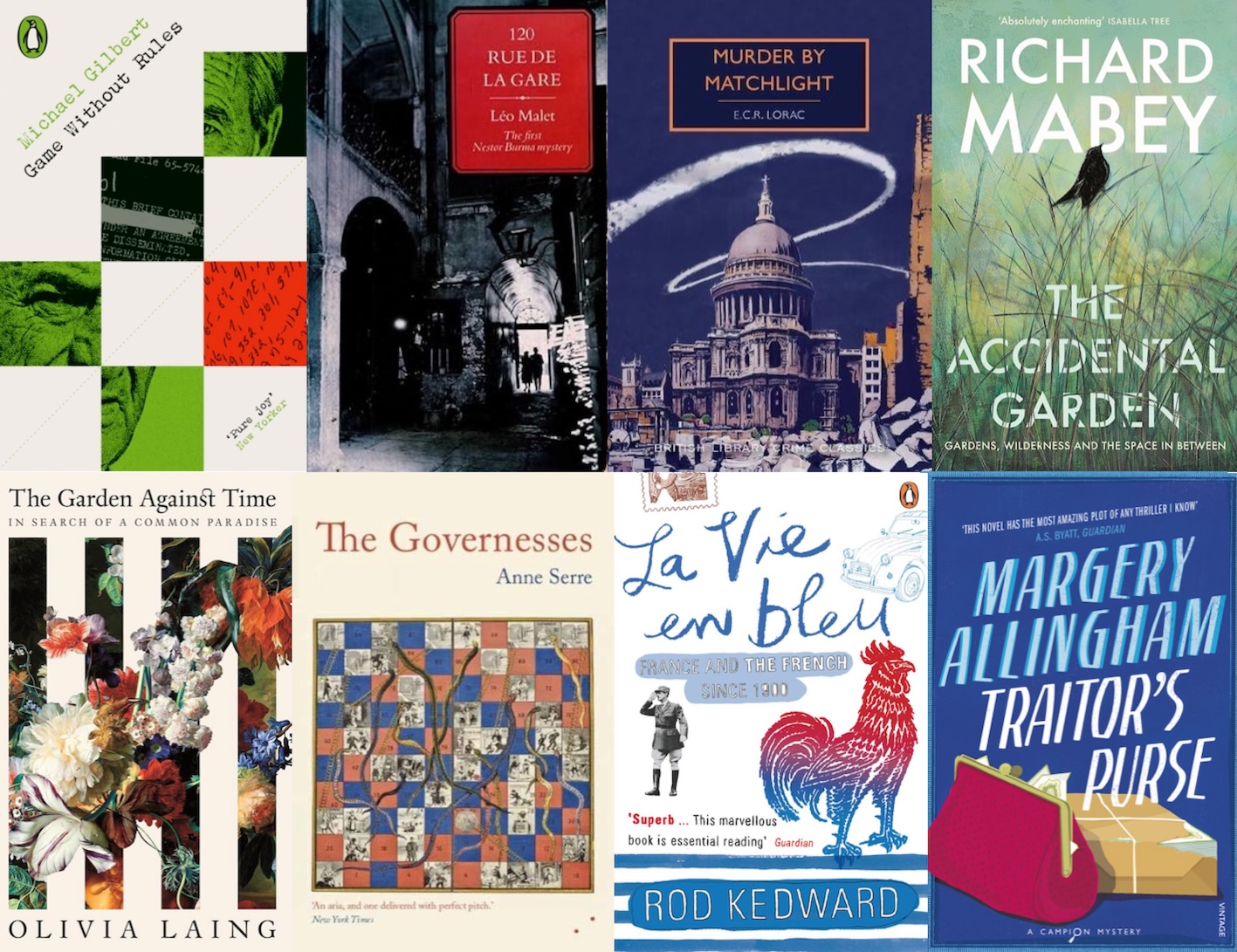
Shown above in the order I read them, but listed below alphabetically:
- 120 Rue de la Gare – Léo Malet. Written in 1943 and the first of Malet’s stories with private detective Nestor Burma. The series as a whole (at least in terms of the 8 books that have been translated) is a window into France under the Occupation and the Post-War period, written contemporaneously (which was something I had been looking for, as opposed to historical fiction). Malet had a colourful life…

- Game Without Rules – Michael Gilbert. A set of short stories revolving around two elderly men named Mr Calders and Mr Behrens. Imagine that the bluff and bluster of Charters and Caldicott were a cover for a pair of vicious old spies often sent to do the dirty mop-up work when jobs go wrong. Gilbert’s Smallbone Deceased is also recommended.
- La Vie en Bleu – Rod Kedward. This is a fairly hefty tome but one of the more enthralling books I read this year. A thorough and engaging history, told ‘from the bottom up’ with genuine interest in the lives of ordinary people. I’ve ordered his book on the French Resistance.
- Murder by Matchlight – E.C.R. Lorac. London during WW2. Another of the Golden Age gateway books for me, and I’ll be tracking down more of her books next year.
- The Accidental Garden – Richard Mabey. On the blurred lines between garden, wilderness, and landscape, and those liminal in-between spaces. I am intending to read more of Mabey’s writing.
- The Garden Against Time – Olivia Laing. How to summarise this? Laing uses her attempted resurrection of a once-famous garden as the framework for exploring the meaning of ‘a garden’ in real and imagined contexts (encompassing Paradise Lost and the poetry of John Clare, as well as Derek Jarman and William Morris, and the darker historical truths that often underlay private Edens). A book I will read again.
- The Governesses – Anne Serre. A fable reminiscent of Angela Carter.
- Traitor’s Purse – Margery Allingham. This starts from what could be a clichéd premise – the hero wakes up with amnesia – but quickly amps up the sense of threat (set early in WW2, Campion has a strong sense that he’s engaged in something of vital importance but can’t remember what it is or who he is, or who he can trust) and clips along at a frenetic pace. I started with Allingham’s later books – namely The Tiger in the Smoke and Hide My Eyes – but this year went back to the start of her Albert Campion series to work through the books in order, and as I said above, I’ll be sorry when I get to the end of them.
Films:
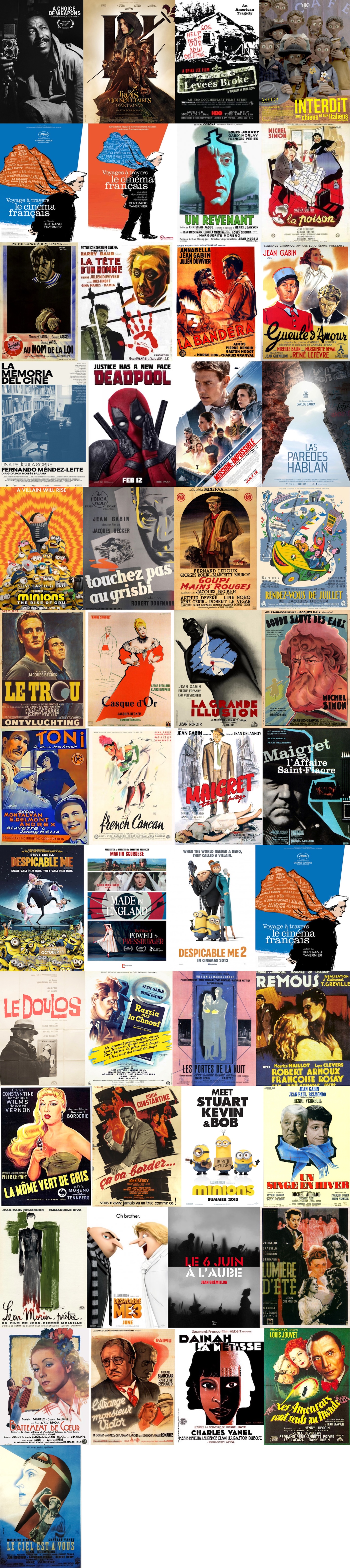
French cinema and Minions, mainly. I set myself a target of 80, but only got to 49. However, I went months at a time without watching anything, and other months when I only watched home renovation programmes on Discovery+, so in the end I didn’t do too badly and almost all of the films I watched were time well spent.
I kept coming back to Bertrand Tavernier as a guide. After an initial shaky start to the year, I rewatched both his film and TV series, and began by watching some of the films that had stood out for one reason or another. First off, the film that Tavernier ends the TV series with – Un revenant (Christian-Jaque, 1946) – with another sublime Louis Jouvet performance. I chose some of the films because I had previously watched other films by the same director (e.g., Au nom de la loi (Maurice Tourneur, 1932), which lacks the finesse of Justin de Marseille (1935), but has an almost documentary realism and interesting details of its milieu, or Julien Duvivier’s La tête d’un homme (1933) with Harry Baur as a world-weary Maigret, and La bandera (1935) where Jean Gabin tries to escape his past but it catches up with him in the form of Robert le Vigan). Then I got a bit more focussed by grouping films by director – first Jacques Becker, then Jean Renoir – before getting distracted by Jean Gabin as Maigret.
I then had one of the longer breaks between watching things, so returned to Tavernier’s film again, and picked out another eight films that seemed important to watch (and were accessible). My tactic at the moment is that I’m rewatching the TV series, but watching the related films after each episode. The first episode focusses on Jean Grémillon, Max Ophuls, and Henri Decoin, and I’ve still got a stack of another half dozen of their films that I want to watch before moving on to the next episode. Not all of the films that I’m watching are featured in the episode, but it’s that rabbit-hole thing of watching one film and it leading you on to another. I’m happy to keep this as a thread in the next year, but will try to also watch films beyond this era of French cinema.
Back in 2020 I said that I might have come to the end of the road with my interest in Spanish cinema (or I couldn’t tell whether it was just part of my general disinterest in cinema at that point). I haven’t picked up on that comment in subsequent years, but Spanish films on my end of year lists have been few and far between. This year I watched two Spanish documentaries: La memoria del cine: una película sobre Fernando Méndez-Leite (Moisés Salama, 2023) and Carlos Saura’s final film, Las paredes hablan (2022). It’s probably time to draw a line under Spanish cinema in terms of intending to write about it, but I think I’m still interested enough to seek films out when I spot them (not least because Spanish films have a tendency to disappear and become completely unavailable).
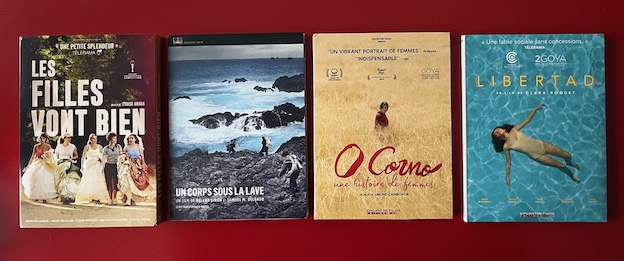
Since 2020 very little independent cinema made in Spain has seen a physical release for home viewing (I’m not only interested in independent cinema / cinema made on the margins in the Spanish context, but that has been a long-time thread through the blog – while there have always been titles that don’t get beyond the festival circuit, there were also usually a decent number that got some kind of DVD release). However, I’ve discovered in the last couple of years (usually when looking for French films) that some of the Spanish titles I’d made note of have had a physical release in France (vive la France!). This year, the films I’ve imported from France include the ones shown above: Las chicas están bien (Itsaso Arana, 2023), Eles transportan a morte (Helena Girón and Samuel M. Delgado, 2021), O corno (Jaione Camborda, 2023), and Libertad (Clara Roquet, 2021). So, no, I’ve not watched them so far, but I’d like to thread some recent Spanish films through my viewing in 2025 (even if it will no longer be a central focus).
I’m not going to give a top 5 for films this time, but…
Some cinematic moments that lingered:
- There’s a sequence in La bandera (Julien Duvivier, 1935) where Gabin’s character is dreaming. He is framed so that his bed goes along the bottom edge of the screen while his dream (remembering the crime that he’s on the run from) is a back projection on the wall above him. His past takes up most of the frame, a weight bearing down on him.
- Goupi Mains Rouges (Jacques Becker, 1943) – wondering whether Goupi Mains Rouges’ (Fernand Ledoux) furry coat was inspiration for Ben Mendelsohn’s in Slow West (John Maclean, 2015)).
- Le Trou (Jacques Becker, 1960) – the physical effort put into the break out.
- Razzia sur la chnouf (Henri Decoin, 1955) – a surprisingly empathetic portrayal of drug addiction via the character of Léa (Lila Kedrova).
- La môme vert-de-gris (Bernard Borderie, 1953) – pulpy fun.
- Seeing the final stages of WW2 from the perspective of the French civilian population in Jean Grémillon’s documentary Le 6 juin à l’aube (1946).
- Danielle Darrieux demonstrating her comic range in Battement de coeur (Henri Decoin, 1940).
- The re-performed meet-cute between Louis Jouvet and Renée Devillers in Les amoureux sont seuls au monde (Henri Decoin, 1948) (which I can only find online with Spanish subs)
I would like to get back into the habit of writing on here, at least as often as I managed in 2023. I don’t want to do a monthly viewing post because when I’ve done that in the past it has just turned into a monthly list. I think it will depend on how much I watch, so I make no promises at this point – but hopefully I’ll post something about what I’ve been watching throughout the year, rather than just at the end!
Thanks for reading – as ever, I wish you health and happiness in the year ahead.
 Nobody Knows Anybody
I can recommend other films by Jacques Becker but I’m guessing you’ve seen all those available in the UK?
Great to read what you’ve been up to.
LikeLike
Thanks, Roy. In terms of what’s available in the UK, I haven’t seen Falbalas, Edward and Caroline, or Montparnasse 19 yet, so I need to catch up with those – I seem to remember that you’ve written about several of them? My favourites of Becker’s films so far have been Antoine and Antoinette (which I watched a couple of years ago), Goupi Mains Rouges, and Le Trou. The French Blu-rays of A&A and GMR have optional English subtitles, and I’ve found that to be the case for quite a few of the films that Pathé and Gaumont have restored and re-issued in the past few years.
LikeLiked by 1 person
Thanks for the info about the French Blu-rays. I’ll possibly check those out. I have posted on Edward and Caroline, Falbalas and Montparnasse 19.
LikeLike
Pingback: My 2025 – Nobody Knows Anybody