Carlos Saura Challenge, Part 1: Los golfos / The Delinquents (1962)

Director: Carlos Saura
Screenplay: Carlos Saura, Mario Camus, Daniel Sueiro
Cast: Luís Marín, Oscar Cruz, Manuel Zarzo, Juanjo Losada, Ramón Rubio, Rafael Vargas, María Mayer.
Synopsis: A gang of juvenile delinquents pool their resources to pay for one of their number to be put on the bill of a bullfighting contest.

Link: My Eye for Film review from 2014.

Link: My original post about the film, on the old version of the blog.

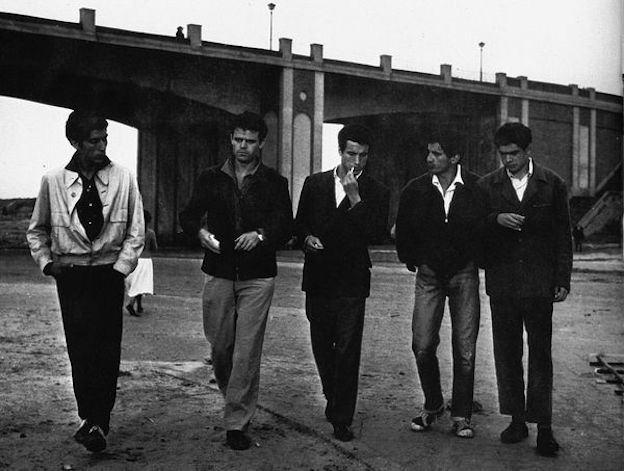
To date, the only one of Carlos Saura’s 39 films that I have watched on the big screen is his directorial debut, Los golfos (1962). The film had long been unavailable in any home viewing format (I don’t think it has ever been released on DVD in Spain) and in my original run of the Carlos Saura Challenge, this was the 7th film I watched because – with no way of obtaining a copy – I’d had to skip it until a fortuitous screening at Manchester’s ¡Viva! Film Festival in 2014. A French DVD was released at the tail-end of 2013, but it has French subtitles only and was made with a far-from pristine print – as you can see from the images below.

The film shows a conscious effort to break away from the studio-set films of the time; wide establishing shots emphasise the urban setting, while domestic scenes play out in locations of palpable poverty and degradation. Unsurprisingly the film fell foul of the Spanish censor (its release was delayed for two years – and ten minutes was cut – after it was shown at Cannes in 1960) because the dreary backdrop builds into an implicit social critique, with the young protagonists (played by non-actors) fully aware that their social environment limits their prospects.

The excised footage appears to have been reinstated in the version I saw – at least there are no obvious gaps as there are in Saura’s subsequent film, Llanto por un bandido (1963) (which jumps about abruptly due to cuts). Although some of the editing choices cause sudden cuts, this would seem to have been deliberate on Saura’s part – to disrupt the ‘normal’ narrative form – rather than due to external tampering. At the time, productions had to go through ‘prior censorship’, the submission of their script before they could start shooting, and because the censors were not production specialists they usually focussed on the narrative form. Saura’s filmmaking to date had been in documentary – and he was not overly interested in questions of narrative – but you can see how the experience of going through major rewrites for Los golfos gave him ‘a deeper understanding of the ideological function of narrative as perceived in the censors’ minds’ (D’Lugo 1991: 33). Saura would subsequently move into a more opaque – or metaphorical – style of cinema, which made it more difficult for the censors to point to concrete elements for removal (although the director has said that this was not his primary motive for using metaphors, rather he had decided that he wanted to be more imaginative in the cinema he made), and with which he would make his name internationally.

There is not much in Los golfos that obviously connects to Saura’s later works besides a questioning of Spanish mythology (via bullfighting in this case) and a nascent interest in dance. The central narrative is that only one of the group has a skill that could prove to be their collective ticket out of there – Juan (Oscar Cruz) shows promise as a bullfighter, but is unable to afford the time to train or the exorbitant fee to enter an actual bullfight. On the prompting of senior member Ramón (Luís Marín), the gang agree to raise the money for Juan’s entrance fee through a series of ever more serious hustles and street robberies.

The robberies are carried out stylishly in the chiaroscuro shadows of a moving elevator or with sharp timing in the blazing sun of a parking lot – there is a slickness to these sequences that is difficult to square with other Saura films. However, the truck stop parking lot robbery reminded me of certain sections of La caza (1965); it’s something to do with the lighting (a blazing sun burns with a white heat that almost comes through the screen), but also the combination of that sharp timing with a certain economy of movement. Although Saura didn’t work with Elías Querejeta and his ‘house team’ (including acclaimed editor Pablo G. del Amo) until La caza, there is a kernel of something here that would blossom in that film. The perception that I’ve come across in my reading is that Saura managed to create his first masterpiece with La caza because he started working with Querejeta and Co. at that point, but the flashes of brilliance in Los golfos suggest that something was already forming.

In front of frame, Chato (Juanjo Losada) waits to give the signal to those outside, while Julian (Manuel Zarzo) is on lookout in the rear of frame. The truck driver is sitting at the table behind Chato.
Chato is looking at the parking lot where Ramón (Luís Marín – in the foreground) relays the signal to Manolo (Rafael Vargas – standing between the trucks), who in turn gives the signal to…
Paco (Ramón Rubio) who proceeds to break into the truck. Saura rapidly cuts between close-ups of each of the men, ramping up the tension.

References:
D’Lugo, M (1991) – The Films of Carlos Saura: The Practice of Seeing, Princeton: Princeton University Press.
The Carlos Saura Challenge: 1962-1979

When I first decided to set myself the challenge of watching all of Carlos Saura’s films (back in 2013), the project had two purposes: to fill in a large gap in my knowledge of Spanish cinema (I had only seen a handful of his films); to occupy myself while I was stuck in part-time employment (a situation I’d been in since graduating with my PhD in 2010). The idea had formed months earlier but it took me some time to track down access to the films (some are only available as VOD but I’m watching the majority on unsubtitled DVDs), and to work out whether I could get hold of enough of them as to make the challenge worthwhile. For a long time a lot of ‘classic’ Spanish films were unavailable in any kind of home viewing format (the label Divisa has been addressing this in the past few years); at this point Saura had 37 feature films to his name (that figure is now currently 39), some of which have never had a DVD release and many of those that had seemed to be OOP. After 6 months I had found/acquired 30 of the films, and so I started the initial run of the challenge in February 2013.

My initial intention of short posts on each film interspersed with longer pieces about groups of the films never really materialised, although I covered 6 of the films in the first couple of months. In May 2013 I finally managed to get a full-time job and I didn’t sustain any momentum with the challenge after that point – the gaps between posts got bigger and bigger, until I stopped altogether. This was partly to do with lack of time (and energy) but also a resistance to having the challenge turn into a chore (e.g. I would have had to watch 2 or 3 Saura films each month in order to stay on my original schedule, which was fine when I was part-time, but now that left very little time for watching anything else) – the enjoyment disappeared. The last time I wrote about a Saura film for the challenge (on the old blog) was in January 2015…and then I ground to a complete halt. But I don’t like leaving things unfinished, and obviously I now own almost all of the films (I have access to 38 of the 39 films – there is only one that I’ve been completely unable to track down).

But I wasn’t particularly motivated to re-start last year because – as I detailed in my end-of-year post – my interest in cinema generally plummeted, as did my enthusiasm for writing about films. I decided to take a break from blogging for the first half of this year. I can’t say that my enthusiasm has reignited but I don’t want to get completely out of the habit of writing (I did so in the aftermath of completing my PhD and it took me a long time to regain any feeling of dexterity with language or confidence in my own voice – a situation I have no wish to repeat). So I started thinking about the Carlos Saura Challenge again – could this be a way of getting back into writing more regularly? I started rewriting the original posts, rewatching some of the films when my memory wasn’t clear enough – rewriting seemed like a good way to ease myself back into writing without being confronted by a completely blank page. Posting as and when I’d watched and written about a film didn’t work the first time around, so my intention was to get everything written and then post all of it together over the course of 4-6 weeks, maybe towards the end of the year (the writing is more important than the publishing). Then doubt set in – am I just setting myself up for a fall given that I’ve always struggled with momentum on this project, and I’ve still only watched a third of the films?

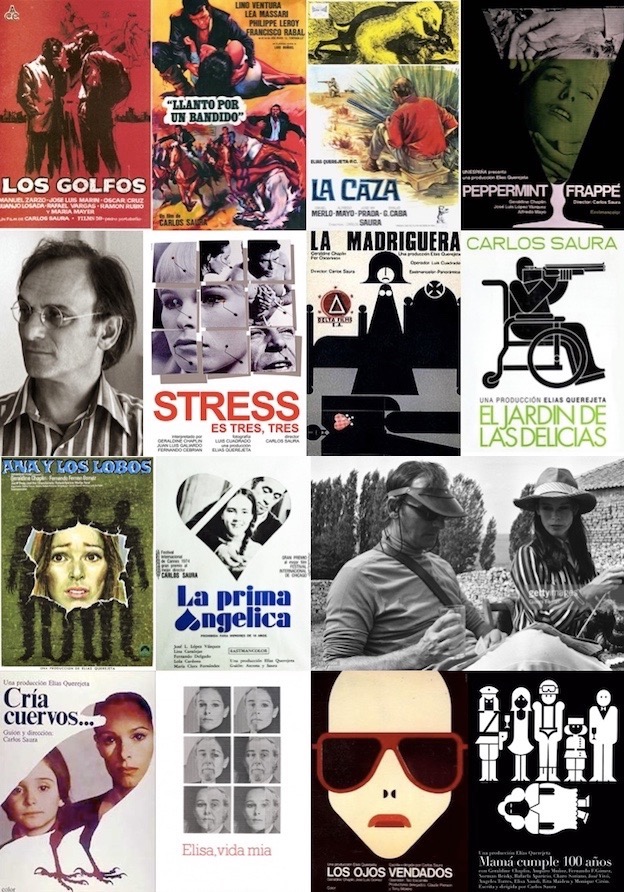
The size of Saura’s filmography is slightly overwhelming – he has been working consistently for more than 50 years. Looking at a list of his films, I started to consider where I could draw possible lines of division to break them into smaller groups. The director has said that his films can be roughly divided into three categories: the ‘musical’ films (although, as he points out, music is important in all of his films); the fictional films; and films that he describes as ‘personal essays’ about figures who have inspired him (e.g. Buñuel and Goya). But I don’t want to divide them along thematic lines (and I’ll say now – as I did during the original run – that I’m not sure exactly how I will approach the musical/dance films because I lack both the technical expertise and vocabulary for those art forms). So rather than theme, or ‘phases’, I’ve gone with decades as the dividing lines: 1962-1979; 1980-1999; 2000-2017. The films don’t divide equally between those time periods (13, 17, and 9 respectively) but this was the simplest way to do it. I am sticking with my plan of writing everything for a given collection and then publishing it as a sequence over a number of weeks, but completing the whole thing this year is unrealistic; given the number of films in the 1980-1999 collection, that set will likely not appear on the blog until early 2018 (with 2000-2017 to probably follow by that summer).

But for the next fortnight, the 1962-1979 schedule is as follows:

  1. Los golfos / The Delinquents (1962) [Mon 3rd]
  2. Llanto por un bandido / Lament for a Bandit (1964) [Tues 4th]
  3. La caza / The Hunt (1966) [Wed 5th]
  4. Peppermint frappé (1967) [Thurs 6th]
  5. Stress es tres, tres / Stress is Three (1968) [Fri 7th]
  6. La madriguera / Honeycomb (1969) [Sat 8th]
  7. El jardín de las delicias / The Garden of Delights (1970) [Sun 9th]
  8. Ana y los lobos / Ana and the Wolves (1973) [Mon 10th]
  9. La prima Angélica / Cousin Angelica (1974) [Tues 11th]
  10. Cría cuervos / Raise Ravens (1976) [Wed 12th]
  11. Elisa, vida mía / Elisa, My Love (1977) [Thurs 13th]
  12. Los ojos vendados / Blindfolded Eyes (1978) [Fri 14th]
  13. Mamá cumple 100 años / Mama Turns 100 (1979) [Sat 15th]

I will add links within the titles as the posts are published.