7th Festival Márgenes: free to view online, 2nd-23rd December 2017

I’ve written about each edition of Festival Márgenes since 2014, usually in the form of an overview but sometimes going into a bit of detail about films I’ve particularly liked (click on the year for the relevant post: 2014, 2015, 2016). The festival focuses on films without distribution, made on the margins (or outside) of existing film industries in the Iberian Peninsula (Spain and Portugal) and Ibero-America (Spanish and Portuguese-speaking Latin American countries). Standouts from previous editions include África 815 (Pilar Monsell, 2014), El gran vuelo (Carolina Astudillo, 2014), La sombra (Javier Olivera, 2015), No Cow on the Ice (Eloy Domínguez Serén, 2015), and Pasaia bitartean (Irati Gorostidi, 2016).

The films included in the 2017 edition (links take you to the relevant streaming page – you need to register with the site to get started):

The Luis Ospina retrospective includes 20 films (shorts and features), also free to view. No indication is given about subtitles, but generally those films not in Spanish have (Castillian) Spanish subtitles and often a lot of the Spanish-language films have English subtitles – but as I’ve said in relation to previous editions, they’re all free to view, so it won’t cost you anything to just click on one and see if subtitles appear.

As I mentioned in my post yesterday, I’m intending to watch the films by Gabriel Azorín, María Cañas, and Luis Macías as a starting point. But my experience of Festival Márgenes is that they always have a really strong line-up – I usually only manage to watch a handful of films from a given edition but I’ve never watched a dud – so although some of the films might not be your kind of thing, you should be able to find something interesting that you would not otherwise get the chance to see.

Watched in November…and things to see in December

One of those months. I watched Chavela (Catherine Gund and Daresha Kyi, 2017) – a documentary about the life and travails of singer Chavela Vargas (who often features on the soundtracks of Almodóvar’s films) – on Filmin.

I want to direct your attention to two online film festivals taking place during December: ArteKino and Márgenes. ArteKino is a Europe-wide initiative (it runs in 45 countries) to support contemporary European arthouse (their term) films by offering a wider audience the chance to view them (film distribution being what it is these days). 10 films – all with subtitles available in French, German, Spanish, and English – are free to view between 1st-17th December. You can see the full line-up here. The selection includes Scarred Hearts (Radu Jude, 2016), one of the few films I’ve seen this year that I can wholeheartedly recommend – catch that one here.

I’ve written about Festival Márgenes for the past few years (last year’s post is here) and will likely write another overview post at some point later in the month. The 7th Festival Márgenes will also make films free to view – in this case, films from the Iberian Peninsula (Spain and Portugal) and Ibero-America (Spanish and Portuguese-speaking Latin American countries), with an emphasis on documentaries and experimental formats. I think the online stage is either due to start tomorrow or on the 10th (it usually runs in the last three weeks of the year) but their website is currently down for maintenance The online stage runs 2nd-23rd December – the official selection can be found on this page(which is loading for me, but I’ve had that window open in my browser for the past week to remind myself about it – so I’m not sure that it will load for other people just now). There is also an online retrospective of the films of Luis Ospina. I don’t know whether all of the films listed will be available online in all geographic locations (there are sometimes restrictions around certain titles) and I have no idea about the subtitle situation. I only ever manage to watch a couple of films in this festival each year, but always find something interesting and worth seeking out – this year I will be aiming to watch (based on what I’ve read about them previously) Expo Lío ’92 (María Cañas, 2017), Los mutantes (Gabriel Azorín, 2016), and 25 Cines/Seg (Luis Macías, 2017). If I have time, I will write an overview in a similar form to previous years – but if not, I still wanted to highlight the festival to anyone who appreciates experimental film-making.

6th Festival Márgenes: free to view online, 11th – 31st December

6th-margenes-festival

I have previously written about the 4th and 5th editions of this Spanish online festival. Specifically dedicated to films – from the Iberian Peninsula (Spain and Portugal) and Ibero-America (Spanish and Portuguese-speaking Latin American countries) – whose form, style, or duration mean that they will struggle to access the normal distribution routes or obtain a commercial release, Márgenes initially takes place in key cities in Spain, Mexico, Chile and Uruguay at the start of December, before moving online during the second half of the month. Documentaries and experimental films tend to dominate the selection.
The online side of the festival makes the films free to view. Sometimes there are rights restrictions on specific titles in certain countries – at the moment Generación Artificial and Santa Teresa y otras historias aren’t visible to me, but I don’t know if that’s a rights issue or just a glitch on the website. Films that aren’t in Spanish tend to have Spanish subtitles, but in past years the majority of the Spanish-language films have had English subtitles. The subtitles aren’t listed on the website – I’ve put a * next to the trailer links below where the festival has used a trailer with English subtitles, which is often a good indication of there being subs on the film as well [UPDATE: this hasn’t been a good indicator this time around]. But given that the films are free to view, you aren’t going to lose anything by starting a film to see whether subtitles appear. I never manage to watch everything, but I will update this post to indicate the presence of subtitles on any films I watch [UPDATE: I’ve watched two and looked at a third – I’ve added the subtitle info below].
The previous editions I’ve explored have revealed gems such as África 815 (Pilar Monsell, 2014), El gran vuelo / The Great Flight (Carolina Astudillo, 2014), and La sombra (Javier Olivera, 2015) (the latter was my favourite in last year’s festival). I can recommend No Cow on the Ice (I reviewed it earlier this year) and personally will be aiming to at least catch Pasaia bitartean, Santa Teresa y otras historias (if it’s available), and Las letras (on the basis that I’ve read positive things about them in relation to other film festivals). The festival announced its prizes yesterday – I’ve marked the winners below as well.
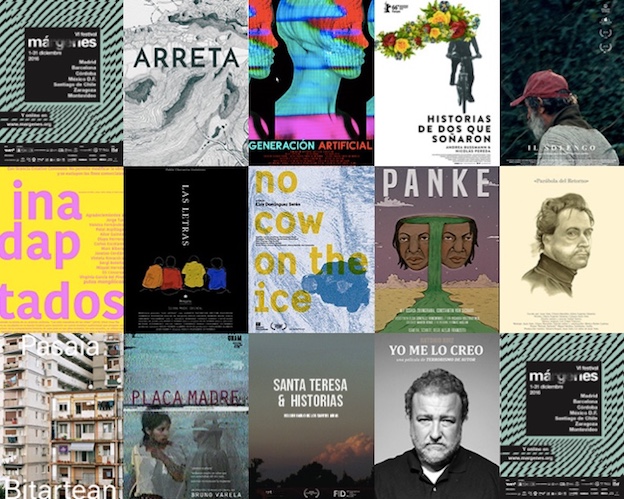
This is the line-up of titles in the 2016 official selection (clicking on the title will take you to the streaming page for that film):

> Arreta (Raquel Marques and María Zafra, 2016, Spain – 60 min) *trailer
> Generación Artificial / Artificial Generation (Federico Pintos, 2015, Argentina – 62 min) *trailer
> Historias de dos que soñaron / Tales of Two Who Dreamt (Andrea Bussmann and Nicolás Pereda, 2016, Mexico/Canada – 82 min) *trailer
> CAMIRA PRIZE: Il solengo (Alessio Rigo de Righi and Matteo Zoppis, 2015, Italy/Argentina – 66 min) trailer
> Inadaptados (Kikol Grau, 2015, Spain – 41 min)
> BEST FILM: Las letras / The Letters (Pablo Chavarría Gutiérrez, 2015, Mexico – 77 min) [with English subtitles] trailer
> SPECIAL MENTION BY THE JURY: No Cow on the Ice (Eloy Domínguez Serén, 2015, Spain – 63 min) *trailer
> Panke (Alejo Franzetti, 2016, Argentina/Germany/Burkina Faso – 46 min) *trailer
> NUMAX EXHIBITION PRIZE: Parábola del retorno (Juan Soto, 2016, Colombia – 41 min) trailer
> Pasaia bitartean (Irati Gorostidi, 2016, Spain – 51 min) [Castilian Spanish subs] *trailer
> Placa Madre / Motherboard (Bruno Varela, 2016, Mexico/Bolivia – 54 min) trailer
> Santa Teresa y otras historias / Saint Teresa and Other Stories (Nelson Carlo de los Santos Arias, 2015, Dominican Republic/USA/Mexico – 65 min) [no subs] *trailer
> Yo me lo creo (Terrorismo de Autor, 2016, Spain – 40 min) trailer

The Márgenes Festival 2016 also includes a retrospective of the work of Lluís Escartín, titled ‘no tengo nada que decir, prefiero escuchar. 30 años documentando lo invisible‘ [I don’t have anything to say, I prefer to listen: 30 years documenting the invisible], and a cycle dedicated to Chilean director José Luis Torres Leiva, ‘Un lugar en el mundo‘ [A place in the world] – they are likewise free to view online until 31st December.

Iberodocs 2016

iberodocs_banner

The 3rd edition of Iberodocs takes place in Edinburgh later this week from Wednesday 4th – Sunday 8th and there is plenty in their programme to recommend. Of the films I’ve seen, I’d recommend Llévate mis amores (which was my favourite documentary at last year’s EIFF), O Futebol and No Cow on the Ice – and also the shorts Ser e voltar (which is paired with the latter feature – both are by Galician filmmakers) and Sin Dios ni Santa María (which appears in the main shorts programme) – but I’ve also heard good things about Rio Corgo and Volta à terra, so I think that the festival is pretty jam-packed with things worth seeing. I have previously reviewed (in relation to different festivals) three of the films that are being shown and I have written another three this past weekend. I will add the links below as they are published over at Eye for Film.

These are likely to be my last reviews for a while, but I hope to get back to writing on here regularly.

Festival Report: AV Festival 2016

Spare Time01

I’ve written a festival report for desistfilm focussing on the AV Festival’s ‘Resistance’ strand, which spanned 80 years of British documentary filmmaking. The report is here.


Reviews: AV Festival 2016

The AV Festival runs from 27th February – 27th March. That’s an unusually long runtime for a festival but there are events and screenings spread throughout that whole month, so my reviews will be appearing over the same time period. That said, quite a lot of the films being shown are ones that I either own on DVD or can access via VOD (for a lower price than a cinema ticket), so I’m currently attempting to get a head start on my reviews by watching those films at home. I’m aiming to review 20 films overall, some of which are screening during the last weekend of the festival so I will add titles and links to this post as and when the reviews go online. The first batches of reviews are for collections of shorts but almost all of the rest will be standalone features.

British Doc shorts

1930s – 40s British Documentary Movement –

Showing as part of the ‘Resistance: British Documentary Film’ strand, this collection of four shorts from the 1930s and 40s picks up on some of the same issues raised by George Orwell in The Road to Wigan Pier – namely poor housing conditions and precarious employment in industrial areas. According to the festival’s website, the screening at the Tyneside Cinema on 1st March will show them on 35mm – I watched them on the BFI’s 4-disc boxset, Land of Promise.


Jennings_Finest Hour

Finest Hour: Films by Humphrey Jennings –

Jennings is perhaps the best-known name among the British documentary makers of the era and is rightly revered for his poetic artistry. What I’ve liked most though is his eye for the small details – often moments of happenstance – that have the spark of real life rather than something stiltedly staged (or self-consciously presented) for the camera. Some of his films are in the Land of Promise boxset – and the BFI also has three volumes of DVDs dedicated to the director – but several of them (indicated below) are also available to watch for free on the BFI Player.


A Dream from the Bath01

Between Times: Marc Karlin –

On the weekend of Friday 4th – Sunday 6th March, AV Festival are focussing on director Marc Karlin (details here) who spent several decades as a filmmaker consistently questioning and critiquing the British Left. I will only manage to see a couple of his films during the festival, but almost all of the films that are being screened (including the five on Nicaragua) are also available to rent on Vimeo courtesy of the Marc Karlin Archive (here) – I’m certainly planning to investigate his other works.


Nightcleaners01

Nightcleaners 

This documentary about the 1970-72 campaign to unionise the cleaners who worked overnight in London office blocks was screened on International Women’s Day. I didn’t have time to write about it until two days later, by which time I felt that something of its quicksilver and abstract nature had already slipped beyond my grasp. It is by no means ‘difficult’ viewing (I hadn’t been sure what to expect – it caused a stir in academic circles at the time of its original release and a lot of the contemporaneous writing about it seems to verge on the incomprehensible) but it is a film of many layers. It is also the best film I’ve seen so far this year.


Revue01

Levels of Democracy: Ukrainian Film Weekend

This weekend (18th-20th March) the AV Festival is focussing on radical Ukrainian documentary. Within that context they are creating a profile of Sergei Loznitsa by screening three of his films – his latest, The Event (2015), as well as Maidan (2014) and Revue (2008). I was supposed to be seeing The Event and two classics from the silent era – Earth (Alexander Dovzhenko, 1930) and Enthusiasm (Symphony of the Donbas) (Dziga Vertov, 1930) – but that is not how my weekend has turned out, so there will only be my review of Revue (available on DVD in a set with his films Blockade and Landscape, which is how I saw it) for this section of the festival. If you’re interested in Loznitsa, Maidan is also available on DVD and the majority of his other documentaries are available as VOD on the Doc Alliance site (note: I wasn’t overly fussed by Revue but I like some of his other films considerably more).

  • Revue (Sergei Loznitsa, 2008)


Refuge England01

March to Aldermaston: Free Cinema

As part of the ‘Resistance: British Documentary Film’ strand, the festival is screening a showcase of shorts from the Free Cinema movement – March to Aldermaston (Lindsay Anderson, 1959), Refuge England (Robert Vas, 1959), and We Are the Lambeth Boys (Karel Reisz, 1959). The latter two are available to watch for free on the BFI Player – here and here respectively.

That’s it from me in terms of AV Festival reviews. My report on the British documentary section will appear after Easter.

Preview: AV Festival 2016

AV Festival_theme

“Meanwhile, what about Socialism? It hardly needs pointing out that at this moment we are in a very serious mess, so serious that even the dullest-witted people find it difficult to remain unaware of it. We are living in a world in which nobody is free, in which hardly anybody is secure, in which it is impossible to be honest and remain alive.” – George Orwell, The Road to Wigan Pier (1937)

I’ve written a preview of the forthcoming AV Festival 2016 over at Eye for Film. The festival takes George Orwell’s The Road to Wigan Pier (1937) as its thematic inspiration, asking “Meanwhile, what about Socialism?”. As I explain within the preview, AV Festival 2016 is billed as ‘Part 1’ in relation to Orwell’s book (which is divided into two parts) with ‘Part 2’ intended to arrive in two year’s time in the form of the festival’s 2018 edition (it’s a biennial festival). I read the book last month and was startled by how much of what Orwell observed and criticised in the late-1930s is still with us in 2016 – it is well worth reading. I’m looking forward to discovering how the festival has interpreted it, not least because I’ve hardly seen anything that they’ve programmed.

Eye for Film have also made a page with the full film listings of the festival – you can see that there is a lot of variety arranged around three themed weekends. I’ll be seeing a bit of everything, including several of the films at the last of those weekends – Levels of Democracy: Ukraine Film Weekend – but my main focus will be the British documentary strand, which is woven throughout the programme over the course of the whole month. I’m also hoping to get to some of the exhibitions and installations that will be at various locations around the city. You can find the full details on the festival’s website – here.

Due to the timescale over which the festival is spread, I will manage to review / write about more individual films than I normally get the chance to at a single festival. I’ll be writing reviews for Eye for Film and a report on the British documentaries for desistfilm. My reviews are already starting to appear, so I will make a separate post tomorrow for the various links.


Five Years

An image from the finale of Nadie conoce a nadie / Nobody Knows Anybody (Mateo Gil, 1999)
Image from the finale of Nadie conoce a nadie / Nobody Knows Anybody (Mateo Gil, 1999)

It is exactly five years since I first started writing on my original Nobody Knows Anybody blog (the picture above was the first header image). I have been unsure of how to mark the occasion given that I stopped writing there (and started this new incarnation) last August when I discovered that the full contents of the site had been ‘scraped’ by a third party. I’ve ended up writing a brief goodbye post there today (it is contained within an image so that it cannot be overwritten). For the past five months I’ve only posted on the original blog when I’ve written about Spanish cinema (the original site focused exclusively on Spanish cinema) for another place – e.g. reviewed a Spanish film or written a festival report that included Spanish works – and in those instances I have simply posted the link with minimal details. I don’t think that there’s much point continuing with that, so now it’s best to just draw a line under it and move on.

That said, while I initially stated that I wouldn’t be reposting old writing on here, I now find myself in two minds on that issue. I had considered choosing a piece of writing from each year and reposting it here (possibly updating certain things) as a way of marking the five years. However, when I went back through the longer pieces, I found that they were a bit like time capsules – you (or I, at least) can see my writing develop from my initial struggles to get away from a more academic mindset (something that I acknowledged or referred to within a lot of the earlier pieces because I was also using the blog to reflect on my writing processes), to becoming more comfortable with expressing my own opinion without recourse to half a dozen other writers to support my argument / point of view. I don’t really want to go backwards. I don’t agree with everything that I’ve written in the past but I also don’t feel the need to rewrite it – it is what it is and reflects where I was at the time. I also think that some of the writing would seem odd in isolation, taken out of its original context (where you can see what else I was writing about in the same period). So that idea bit the dust.

On the other hand, there are certain posts that I would like to ‘take with me’ – either because they’re part of something that I haven’t finished yet, or things that I’d like to revisit (here I’m thinking specifically of the two ‘anatomy of a scene’ posts [on La madre muerta and Los lunes al sol] where I used multiple still images to try and convey either gesture or camera movement – I’m wondering whether I could redo them with gifs?), or a few about films that I really connected with. All of these posts were original pieces written specifically for the blog – i.e. I am not talking about the posts that I adapted from my PhD thesis. I think initially this would not involve more than half a dozen posts, plus the Carlos Saura ones (although that challenge has dragged on for so long that those posts are a sequence where you can see a definite change in my writing over time – I may rewrite some of the earlier ones). If I actually find the time to get properly back into my ‘el otro cine español’ / Spanish documentary project, then there are possibly a few more pieces that I would revisit and rewrite rather than just reposting – but I’ll only do that if I feel that I’m going to have the time to invest in that project.

The ‘blog birthday’ posts are also usually where I outline plans for the coming year in terms of what I want to write about. My year has got off to a slow start because I haven’t been very well but I’m hoping that the worst is over with and I can start organising myself again. The AV Festival takes place in my home city between 27th February – 27th March. For that reason, my February and March will mainly be taken up with that (I have a lot of the films involved on DVD, so I’ll be watching some of them before the festival begins). With that in mind – and so as not to annoy people by posting all of the stuff from the old blog within the space of a week – I think I’ll start by posting one older piece each week, to spread it out. The ‘anatomy of a scene’ ones may have to wait a bit longer because I don’t know that I’ll have enough free time to sort out the images within that timescale. But given that I won’t be attempting to restart the Carlos Saura Challenge until after the AV Festival, the reposting/rewriting of those posts could also present a lead in to that. My AV Festival coverage will begin soon.

Last year I managed to attend two film festivals abroad and two in the UK. Travelling abroad is unlikely to be financially viable for me this year (unless I find another opportunity like the one that took me to Gijón) but I’ve been looking at a broader range of possible UK festivals. For example, the ¡Viva! Spanish and Latin American Film Festival in Manchester is returning to its normal format this year (it was divided into three weekends at different times of the year in 2015), which may mean that a trip to Manchester is a) feasible and b) worthwhile (that is obviously also dependent on what they programme). Beyond that I should manage Edinburgh and Berwick again…..and I’ve noted down some other possibilities for the second half of the year as well. Other writing plans? I want to write something about the Spanish documentaries (mentioned here – and the Edificio España piece that I refer to within that post is one of the ones that I want to relocate here), I’m intending to write about two films – África 815 and La sombra – from the last two Márgenes online festivals that I think have interesting parallels, I’m mulling over an idea in relation to Life May Be but need a decent stretch of free time to properly explore it, oh and a certain man from La Mancha has a new film out this year (scheduled for release in the UK at the end of August) – I don’t think I’ll be able to do something as full on as the Almodóvarthon that I did in 2011 (I was only working PT then), but I would hope to do something about Pedro at that point. That seems like a decent schedule to be getting on with for the time being.

Festival Report: Asturian shorts

Cuenta con nosotros_Dani Pérez Prada and David Pareja

More than 70 shorts were screened in Gijón – films from around the world, in and out of competition. I concentrated on the Spanish ones (for obvious reasons) but even then I didn’t manage to see all of them. In the end I’ve written about some of the ones that were in the Asturian section – I’m not familiar with cinema from the region, so this seemed like a good place to start. If you cast your mind back to my Gijón dispatches, you may remember that I had one evening when I wasn’t well and ended up returning to the hotel rather than going to the final session of the night. That session was for the Asturian films that were in competition, so I’d like to thank Alicia Albares, Roberto F. Canuto, Pablo A. Neila, Kiko and Javier Prada, Pablo Vara, Daniel Vázquez, and Benjamín Villaverde for giving me access to their respective films after the fact. For reasons of space, I could only focus on three of the films in my report, but hopefully I will have the occasion to write about the others in the future. My report can be found over at Eye for Filmhere.

5th Festival Márgenes: free to view online 13th-31st December

Festival Margenes 2015

The first online festival in Spain specifically dedicated to films without a commercial release or without access to the normal methods of distribution, Festival Márgenes is now in its fifth year and continues to celebrate and support filmmakers and films committed to offering alternative perspectives on both cinema and society. The full list of criteria that the films have to meet can be found here – but essentially they have to be more than 40 minutes long, to have not been distributed, and to originate from a specific set of countries (Argentina, Bolivia, Brazil, Chile, Colombia, Costa Rica, Cuba, Dominican Republic, Ecuador, El Salvador, Guatemala, Honduras, México, Nicaragua, Panama, Paraguay, Peru, Portugal, Puerto Rico, Spain, Uruguay and Venezuela). The films can be of any genre, although it’s noticeable that documentaries tend to feature strongly.
The festival takes place in cinemas in Madrid, Monterrey, Barcelona, Montevideo, Córdoba, México DF, and Santiago de Chile from the 3rd December and then moves online from the 13th until the 31st. The films are all available to stream for free (although there are a couple that aren’t viewable outside of specified locations – noted below). There are Spanish subtitles on films that aren’t in Spanish, but as far as I’m aware there are no English subtitles this year. But even if your Spanish is rudimentary, I’d encourage you to give it a go – a) because cinema communicates through visuals (and non-verbal sound) at least as much as it does through verbal interactions, b) you have the chance to watch some films that you possibly won’t encounter elsewhere.
I haven’t had time to start watching the 2015 selection yet, but I wrote about the 4th edition last year and saw several films that I really liked – namely África 815 (Pilar Monsell, 2014) [UPDATE Oct 2016: the film is available to rent on the Márgenes VOD platform – there’s no indication whether subtitles are included], El gran vuelo / The Great Flight (Carolina Astudillo, 2014) [UPDATE Oct 2016: also available to rent – likewise, no indication of subtitles], and Propaganda (Colectivo MAFI, 2014). Hopefully I’ll manage to watch more this year. The festival prizes have already been awarded (indicated below – but see the website for full details / jury citations and the breakdown of what the prizes entail), so I will prioritise those titles but I also want to see Revolução Industrial [Industrial Revolution] (which I’m sure I read about last year in relation to other festivals), Transeúntes (which was recently at the Seville Film Festival), and the special bonus film (not part of the competition) Ragazzi (Raúl Perrone, 2014) – I saw Perrone’s Favula in Barcelona earlier in the year (my review) and would like to see if his other films maintain the fevered rarity of that one. So basically I need more hours in the day between now and the end of the year.
It’s also worth pointing out that Márgenes has its own VOD catalogue outside of the festival – a mixture of shorts and features (some viewable for free, others pay-per-view for a modest fee) and all at the more original and idiosyncratic end of Spanish production, including several films I’ve written about previously (for example, Edificio España (Víctor Moreno, 2013) and Branka (Mikel Zatarain, 2013)).

Anyway, the full list of films in the 2015 official selection is below – clicking on the title will take you to the streaming page for that film. I will post something further when I’ve managed to watch some of the films. UPDATE (28/12/15): I’ve started watching the films and will add * next to the title if I find that they have English subtitles (note: I’m only going to have time to watch a few, so if you’re interested I suggest that you try streaming them to see whether subtitles appear). UPDATE (Oct 2016): several of the films from this collection are now available to rent on the Márgenes VOD platform – note that subtitles aren’t mentioned, although that doesn’t necessarily mean that there aren’t any (that was also the case during the festival period and all of the ones that I watched had subs).

Alexfilm (Pablo Chavarría, 2015), Mexico, 60 min.
As cidades e as trocas (Luísa Homem and Pedro Pinho, 2014), Portugal, 139 min.
El corral y el viento* (Miguel Hilari, 2014), Bolivia, 55 min. BEST FILM
La extranjera (Miguel Ángel Blanca, 2015), Spain, 70 min [only available in Spain].
La maldad* (Joshua Gil, 2015), Mexico, 74 min. SPECIAL MENTION BY THE JURY
La sombra* (Javier Olivera, 2015), Argentina, 72 min. CAMIRA PRIZE
L’Esma del Temps (El Sentido del Tiempo) (Alexandra Garcia-Vilà, Marta González, Marta Saleta, 2015), Spain, 54 min. HONORARY MENTION
Microbús (Alejandro Small, 2014), Peru, 44 min.
Navajazo (Ricardo Silva, 2014), Mexico, 75 min. [only available in Spain, Mexico, Chile & Uruguay].
Next (Elia Urquiza, 2015), Spain / USA, 72 min.
Revolução Industrial (Frederico Lobo and Tiago Hespanha, 2014), Portugal, 72 min.
Tú y Yo (Oriol Estrada and Natalia Cabral, 2014), Dominican Republic, 85 min. EXHIBITION PRIZE
Transeúntes* (Luis Aller, 2015), Spain, 101 min.
Festival Report: Gijón, part 2

Transatlantique_09

The second of two reports I’ve written for desistfilm about films I saw in Gijón is now online. This one focuses on the Convergencias films – in essence, I’ve looked at what the films have in common (interesting use of sound / silence and idiosyncratic visuals).

Links to reviews will continue to appear in the other post(s).

UPDATE (29/12/15): the 1-hour recording of El séptimo vicio that centred on Convergencias is now online (here). I am in the first twenty minute section (specifically 04:20-09:21) alongside Félix Dufour-Laperrière and Víctor Paz. The middle section consists of Martín Cuesta, Pablo González-Taboada, Eduardo Guillot, Carlota Moseguí and David Tejero discussing the state of film criticism in Spain, and then the final section is Martín and Víctor.

Reviews: Gijón

Dead-slow-ahead

I have a few reviews of films I saw in Gijón forthcoming over at Eye for Film. I’m starting with three of the features (I will add links to this post as and when they are published), but there will also be something on (some of) the Spanish shorts – I haven’t decided whether this is going to entail reviews, a report, or some combination of the two. I will either extend this post to include links to reviews of the shorts or write a separate post for them – it’ll depend on what I end up writing.

UPDATE (21/12/15), a review of one of the short films in the main competition:

I interviewed Adán Aliaga earlier in the year in relation to his feature (co-directed with David Valero), El arca de Noé / Noah’s Ark – that interview can be found here.