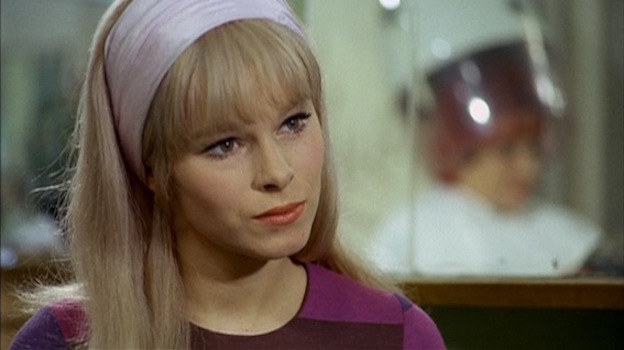
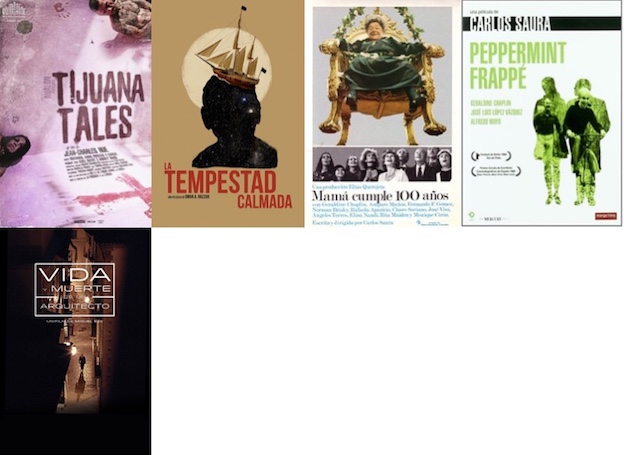
Director: Carlos Saura Screenplay: Carlos Saura, Angelino Fons, and Rafael Azcona Cast: Geraldine Chaplin, José Luis López Vázquez, Alfredo Mayo. Synopsis: Julián’s childhood friend Pablo returns to their hometown with his new wife, Elena. Julián becomes obsessed with Elena, who reminds him of a woman he saw beating a drum during the famous Holy Week ritual in Calanda. Although rebuffed, Julián continues his pursuit while simultaneously remodelling his assistant, Ana, in her image.
Peppermint frappé is dedicated to Luis Buñuel (and there is a lot of Buñuelian sexual fetishising going on) but the director who most sprang to mind from the opening credits – with Julián (José Luis López Vázquez) assiduously cutting out images from women’s fashion magazines and pasting them into a scrapbook – was Pedro Almodóvar. Except, of course, Pedro’s career didn’t start until more than a decade later. Obviously Buñuel also had a strong influence on Almodóvar, but the central conceit of Peppermint frappé – a man is driven mad by jealousy and sexual obsession, and attempts to mould one woman into the image of another before moving on to murder – and the way in which the women are effectively reduced to the accoutrements of femininity (false eyelashes, lipstick, lace stockings), struck me as being particularly Almodóvarian. I wasn’t expecting to see connections between Saura and Almodóvar because they’ve always seemed to me to be very different filmmakers in both style and content, but it would appear that their common influences allow for some crossover.
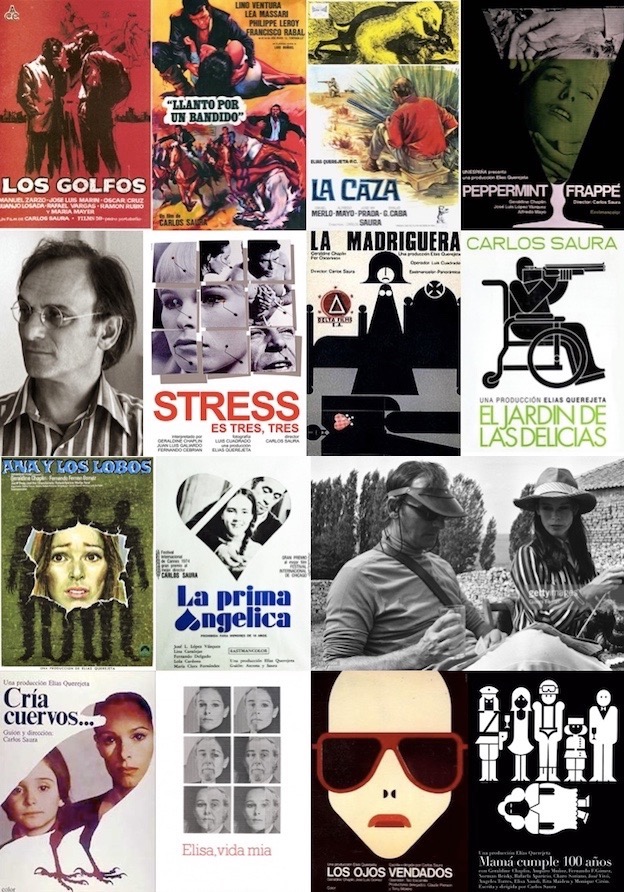
The film marks Saura’s first collaborations with two actors who would be key figures in his films of the next 10-12 years: José Luis López Vázquez and Geraldine Chaplin. I personally think that López Vázquez’s best performance for Saura is in La prima Angélica (1974), but he is never less than great. Longstanding director/actor collaborations – and the idea of directors having what the Spanish call an actor fetiche (not necessarily a lead actor, but an indispensable member of the director’s habitual team) – often receive a lot of critical attention, but I have yet to encounter any writing that specifically examines the Saura/Chaplin films from that perspective. Chaplin and Saura’s professional (and romantic) relationship lasted for eight films: Peppermint frappé, Stress es tres, tres (1968), La madriguera (1969), Ana y los lobos (1973), Cría cuervos (1976), Elisa, vida mía (1977), Los ojos vendados (1978), and Mamá cumple 100 años (1979).
Peppermint frappé forms a trilogy of sorts with the pair’s two subsequent films – Stress es tres, tres and La madriguera. Collectively the three films explore dysfunctional relationships, with the later two focussing on duplicitous games between husbands and wives. But this first film also begins the recurring motif of Chaplin playing multiple women within the same film, or multiple versions (either real or imagined) of the same woman – this is a common thread across most of the films she made with Saura. Here she plays three characters within the narrative: Elena, the new wife of Julián’s boyhood friend, Pablo (Alfredo Mayo); Ana, Julián’s assistant in his medical practice; and the unnamed woman in Calanda, who made such a powerful impression on Julián. The last woman is ‘performed’ (or impersonated) by both Elena and Ana in different contexts, but Chaplin delineates all three women through her performance(s) – body language, voice, facial expressions – as well as costume.
Watching the film again, four years after the first time, there were a couple of things that stood out. I was struck by how spiteful Pablo and Elena are to Julián; the sly digs are there from the start, but before long they openly mock him and his foibles. Also, the degree of manipulation being applied to Ana is more open to interpretation than I remembered: she knows that she is being shaped to resemble someone else, and by the end of the film is complicit in her transformation (and Julián’s other actions). Chaplin often portrays a kind of ‘new woman’ in the Saura films, and her foreignness (or non-Spanishness) is key to how he positions her as representing the arrival of modernity in Spain – highlighting the resulting discord when the modern is juxtaposed with the social norms favoured and promoted by the Franco regime. Her characters are often disruptive forces within male worlds, and the three women she plays in Peppermint frappé encapsulate certain elements that she and the director would refine over time. The film also shows Saura’s aptitude for experimenting with style and pace – it is very different to the three films that precede it, although certain elements are constant (e.g. the elegance with which he frames actors within defined spaces within the frame – windows and mirrors are frequently used in this film – and the centrality of music as expression of character).
Director: Carlos Saura Screenplay: Carlos Saura and Angelino Fons Cast: Ismael Merlo, Alfredo Mayo, José María Prada, Emilio Gutiérrez Caba, Fernando Sánchez Polack, Violeta García. Synopsis: Old ‘friends’ José, Paco, and Luis reunite after eight years for a day’s hunting, with Paco’s brother-in-law Enrique also enthusiastically tagging along. As the day wears on, old tensions become apparent and violence bubbles to the surface.
Generally considered Carlos Saura’s first masterpiece, La caza won the Silver Bear at the Berlin Film Festival in 1966 (the director’s first international award) and is a landmark in Spanish cinema, one of the most representative films of what became known as Nuevo cine español [New Spanish Cinema]. It also marks a new stage in Saura’s career as the first of his collaborations with producer Elías Querejeta, and represents a stylistic leap on from Llanto por un bandido courtesy of Luis Cuadrado’s cinematography and the sharp editing of Pablo G del Amo (two members of Querejeta’s preferred team of technical crew).
Watching the film today – and cognisant of Saura’s continuous problems with the censor – it’s somewhat amazing that the film exists as it does. Set over the course of one scorching day as four men – former colleagues José (Ismael Merlo), Paco (Alfredo Mayo) and Luis (José María Prada), along with Paco’s brother-in-law, Enrique (Emilio Gutiérrez Caba) – hunt rabbits in the arid countryside. The film takes place in a location (specified in titles at the start of the film) that had been a battlefield during the Civil War, and ‘the war’ (the censors ensured that the Civil War is not explicitly mentioned) permeates the narrative and the relations between the men (the older three served together). Saura cannily employs the landscape as a metonym for the psyches of those who survived the war: battle-scarred, with secrets and remnants of violence hidden in darker recesses. In The A-Z of Spanish Cinema, Alberto Mira observes that the use of metaphor and strong imagery ‘went beyond narrative needs: the heat that drives characters to madness could be read in terms of the stifling atmosphere created in the country after the Civil War, and the butchery was easily read as a reference to the conflict itself […]’ (2010: 71).
For the most part the film is realist in its depictions, but frequent extreme close-ups of sweating faces (a technique that also signals how claustrophobically trapped each man is in his own behaviour), weapons and ammunition – and of rabbits in their death throes – ramp up the tension and give a slightly surreal edge to proceedings. It’s almost a ‘heightened’ reality, as if the camera is feeling the effects of that relentless heat. It feels like a very modern film, not just visually but also in our access to the interiority of the characters, conveyed through their private thoughts in voiceover and also in having them break the fourth wall in moments of honesty and confrontation (although talking to each other, they individually face directly into the camera as they speak). Likewise their states of mind – or at least the unspoken animosity under the surface – is signalled early on via the editing in the sequence where the men are preparing their weapons: a series of shot-reverse-shots show Paco in extreme close-up checking his sites facing right, then cuts to an extreme close-up of José doing the same but facing left (making it appear that they could be aiming at each other). The sequence of shots then repeats before a mid-distance shot establishes their actual positions in relation to each other (sitting alongside one another facing in opposite directions).
Saura’s use of the implicit includes the casting of Alfredo Mayo, who had a particular set of associations for contemporaneous Spanish audiences. As Marvin D’Lugo explains in his book on Saura’s films:
‘As a young man, Mayo built his career upon a series of forties films playing the role of the stalwart Nationalist hero fighting the Republican scourge. By far, the most influential of these was the role of José Churruca in Sáenz de Heredia’s Raza. Not only did Mayo play the part of the nationalist patriot; his role was fashioned as a sanitised version of the Caudillo, replete with narrative parallels to Franco’s own biography. Nowhere in [La caza] is there any overt reference to Mayo’s former screen persona, yet implicitly, the character of Paco seems to represent a sequel to the earlier Alfredo Mayo, film-actor-as-national-hero. It is a shattering statement of the passage of time and the transformation of a bygone mythic hero into a venal and narcissistic old man.’ (1991: 57)
In contrast, as an outsider to this clique – and crucially of a younger generation – Enrique is at one remove from the associations generated by the older men. He therefore acts as witness, and audience proxy, when bitter resentments and disappointments finally cause a breakdown and the men turn on each other with spectacular violence. The film ends with a freeze frame of his face in profile – his panting still audible on the soundtrack – as he runs from the scene in horror.
References:
D’Lugo, M (1991) – The Films of Carlos Saura: The Practice of Seeing, Princeton: Princeton University Press.
Mira, A. (2010) – The A to Z of Spanish Cinema, Plymouth: The Scarecrow Press.
Director: Carlos Saura Screenplay: Carlos Saura and Mario Camus Cast: Francisco Rabal, Lea Massari, Lino Ventura, Philippe Leroy, Manuel Zarzo, Agustín González, Fernando Sánchez Polack Synopsis: 19th century Spain. The Spanish people have expelled the French but now have to deal with the unjust Fernando VII in their stead. A group of bandits led by ‘El Tempranillo’ garner a Robin Hood-like reputation by robbing only the rich, dealing fairly with normal people, and continuing to defy the King.
The reception of Los golfos had demonstrated that depicting the Spanish here-and-now was a sensitive issue with the dictatorship’s censors, but if Saura thought that delving into historical drama might allow him some leeway, he was mistaken: Llanto por un bandido (1964) was heavily cut. The opening sequence in particular has been mangled so heavy-handedly that I thought my DVD had jumped a chapter. Here Saura mischievously used playwright Antonio Buero Vallejo (who deployed symbolism in his own work to criticise the Franco regime) as the town-crier, while Luis Buñuel (persona non grata in Spain at this point due to Viridiana (1961)) cameos as an executioner preparing to execute the condemned men by garrotting.
Whether because of the gaps left by the ‘editing’ or my own lack of familiarity with the historical period, I didn’t really pick up on the political subtext with which Saura apparently imbued this tale of a bandit (‘El Tempranillo’, played by Paco Rabal) who acquires a certain level of political consciousness when he comes into contact with a fugitive liberal – the argument for ideological commitment was seen as provocative. To be honest, I took his defiance of the King to be your normal bandit behaviour rather than an indication of solidarity with the Constitutionalists – the character is generally a bit of a thuggish arsehole, so the association seemed to be one of expedience as opposed to ideological inclination.
Overall, it’s not really my sort of film – I also haven’t rewatched it since my original run of the Carlos Saura Challenge, and there isn’t much about it that has stuck with me.
However – aside from providing Saura with additional impetus to be more oblique when presenting politically contentious perspectives – there are a number of elements that are significant in terms of how Saura’s cinematic style developed. Saura’s evident eye for painterly allusions and compositions – which José Arroyo highlights in a post on the film – can be seen most obviously in the homage to Goya’s Duelo a garrotazos / Fight with Cudgels in the fight sequence between Rabal (who several decades later would play the artist for Saura in Goya en Burdeos (1999)) and Lino Ventura where, buried up to their knees, they batter each other with branches. There is also already a distinctive use of music. This is manifested in the way that sequences are either cut to the music or actions on camera are timed to follow the rhythm of the music (for example, in the Rabal/Ventura fight scene their blows fall in time) in a way that seems unusual (to me) for the time. But it is also very striking that the music is often diagetic, i.e. we see the music being performed onscreen within the scene, emphasising musical performance (and specifically the performance of traditional forms of music from Spain, most obviously flamenco) in a way that would become one of the director’s trademarks.
Director: Carlos Saura Screenplay: Carlos Saura, Mario Camus, Daniel Sueiro Cast: Luís Marín, Oscar Cruz, Manuel Zarzo, Juanjo Losada, Ramón Rubio, Rafael Vargas, María Mayer. Synopsis: A gang of juvenile delinquents pool their resources to pay for one of their number to be put on the bill of a bullfighting contest.
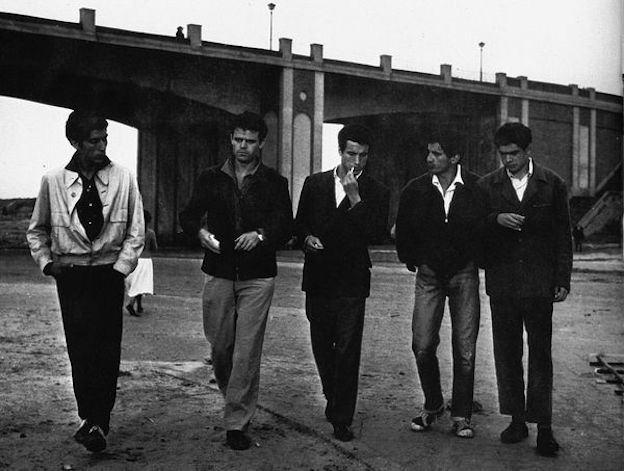
To date, the only one of Carlos Saura’s 39 films that I have watched on the big screen is his directorial debut, Los golfos (1962). The film had long been unavailable in any home viewing format (I don’t think it has ever been released on DVD in Spain) and in my original run of the Carlos Saura Challenge, this was the 7th film I watched because – with no way of obtaining a copy – I’d had to skip it until a fortuitous screening at Manchester’s ¡Viva! Film Festival in 2014. A French DVD was released at the tail-end of 2013, but it has French subtitles only and was made with a far-from pristine print – as you can see from the images below.
The film shows a conscious effort to break away from the studio-set films of the time; wide establishing shots emphasise the urban setting, while domestic scenes play out in locations of palpable poverty and degradation. Unsurprisingly the film fell foul of the Spanish censor (its release was delayed for two years – and ten minutes was cut – after it was shown at Cannes in 1960) because the dreary backdrop builds into an implicit social critique, with the young protagonists (played by non-actors) fully aware that their social environment limits their prospects.
The excised footage appears to have been reinstated in the version I saw – at least there are no obvious gaps as there are in Saura’s subsequent film, Llanto por un bandido (1963) (which jumps about abruptly due to cuts). Although some of the editing choices cause sudden cuts, this would seem to have been deliberate on Saura’s part – to disrupt the ‘normal’ narrative form – rather than due to external tampering. At the time, productions had to go through ‘prior censorship’, the submission of their script before they could start shooting, and because the censors were not production specialists they usually focussed on the narrative form. Saura’s filmmaking to date had been in documentary – and he was not overly interested in questions of narrative – but you can see how the experience of going through major rewrites for Los golfos gave him ‘a deeper understanding of the ideological function of narrative as perceived in the censors’ minds’ (D’Lugo 1991: 33). Saura would subsequently move into a more opaque – or metaphorical – style of cinema, which made it more difficult for the censors to point to concrete elements for removal (although the director has said that this was not his primary motive for using metaphors, rather he had decided that he wanted to be more imaginative in the cinema he made), and with which he would make his name internationally.
There is not much in Los golfos that obviously connects to Saura’s later works besides a questioning of Spanish mythology (via bullfighting in this case) and a nascent interest in dance. The central narrative is that only one of the group has a skill that could prove to be their collective ticket out of there – Juan (Oscar Cruz) shows promise as a bullfighter, but is unable to afford the time to train or the exorbitant fee to enter an actual bullfight. On the prompting of senior member Ramón (Luís Marín), the gang agree to raise the money for Juan’s entrance fee through a series of ever more serious hustles and street robberies.
The robberies are carried out stylishly in the chiaroscuro shadows of a moving elevator or with sharp timing in the blazing sun of a parking lot – there is a slickness to these sequences that is difficult to square with other Saura films. However, the truck stop parking lot robbery reminded me of certain sections of La caza (1965); it’s something to do with the lighting (a blazing sun burns with a white heat that almost comes through the screen), but also the combination of that sharp timing with a certain economy of movement. Although Saura didn’t work with Elías Querejeta and his ‘house team’ (including acclaimed editor Pablo G. del Amo) until La caza, there is a kernel of something here that would blossom in that film. The perception that I’ve come across in my reading is that Saura managed to create his first masterpiece with La caza because he started working with Querejeta and Co. at that point, but the flashes of brilliance in Los golfos suggest that something was already forming.
In front of frame, Chato (Juanjo Losada) waits to give the signal to those outside, while Julian (Manuel Zarzo) is on lookout in the rear of frame. The truck driver is sitting at the table behind Chato.Chato is looking at the parking lot where Ramón (Luís Marín – in the foreground) relays the signal to Manolo (Rafael Vargas – standing between the trucks), who in turn gives the signal to…Paco (Ramón Rubio) who proceeds to break into the truck. Saura rapidly cuts between close-ups of each of the men, ramping up the tension.
References:
D’Lugo, M (1991) – The Films of Carlos Saura: The Practice of Seeing, Princeton: Princeton University Press.
When I first decided to set myself the challenge of watching all of Carlos Saura’s films (back in 2013), the project had two purposes: to fill in a large gap in my knowledge of Spanish cinema (I had only seen a handful of his films); to occupy myself while I was stuck in part-time employment (a situation I’d been in since graduating with my PhD in 2010). The idea had formed months earlier but it took me some time to track down access to the films (some are only available as VOD but I’m watching the majority on unsubtitled DVDs), and to work out whether I could get hold of enough of them as to make the challenge worthwhile. For a long time a lot of ‘classic’ Spanish films were unavailable in any kind of home viewing format (the label Divisa has been addressing this in the past few years); at this point Saura had 37 feature films to his name (that figure is now currently 39), some of which have never had a DVD release and many of those that had seemed to be OOP. After 6 months I had found/acquired 30 of the films, and so I started the initial run of the challenge in February 2013.
My initial intention of short posts on each film interspersed with longer pieces about groups of the films never really materialised, although I covered 6 of the films in the first couple of months. In May 2013 I finally managed to get a full-time job and I didn’t sustain any momentum with the challenge after that point – the gaps between posts got bigger and bigger, until I stopped altogether. This was partly to do with lack of time (and energy) but also a resistance to having the challenge turn into a chore (e.g. I would have had to watch 2 or 3 Saura films each month in order to stay on my original schedule, which was fine when I was part-time, but now that left very little time for watching anything else) – the enjoyment disappeared. The last time I wrote about a Saura film for the challenge (on the old blog) was in January 2015…and then I ground to a complete halt. But I don’t like leaving things unfinished, and obviously I now own almost all of the films (I have access to 38 of the 39 films – there is only one that I’ve been completely unable to track down).
But I wasn’t particularly motivated to re-start last year because – as I detailed in my end-of-year post – my interest in cinema generally plummeted, as did my enthusiasm for writing about films. I decided to take a break from blogging for the first half of this year. I can’t say that my enthusiasm has reignited but I don’t want to get completely out of the habit of writing (I did so in the aftermath of completing my PhD and it took me a long time to regain any feeling of dexterity with language or confidence in my own voice – a situation I have no wish to repeat). So I started thinking about the Carlos Saura Challenge again – could this be a way of getting back into writing more regularly? I started rewriting the original posts, rewatching some of the films when my memory wasn’t clear enough – rewriting seemed like a good way to ease myself back into writing without being confronted by a completely blank page. Posting as and when I’d watched and written about a film didn’t work the first time around, so my intention was to get everything written and then post all of it together over the course of 4-6 weeks, maybe towards the end of the year (the writing is more important than the publishing). Then doubt set in – am I just setting myself up for a fall given that I’ve always struggled with momentum on this project, and I’ve still only watched a third of the films?
The size of Saura’s filmography is slightly overwhelming – he has been working consistently for more than 50 years. Looking at a list of his films, I started to consider where I could draw possible lines of division to break them into smaller groups. The director has said that his films can be roughly divided into three categories: the ‘musical’ films (although, as he points out, music is important in all of his films); the fictional films; and films that he describes as ‘personal essays’ about figures who have inspired him (e.g. Buñuel and Goya). But I don’t want to divide them along thematic lines (and I’ll say now – as I did during the original run – that I’m not sure exactly how I will approach the musical/dance films because I lack both the technical expertise and vocabulary for those art forms). So rather than theme, or ‘phases’, I’ve gone with decades as the dividing lines: 1962-1979; 1980-1999; 2000-2017. The films don’t divide equally between those time periods (13, 17, and 9 respectively) but this was the simplest way to do it. I am sticking with my plan of writing everything for a given collection and then publishing it as a sequence over a number of weeks, but completing the whole thing this year is unrealistic; given the number of films in the 1980-1999 collection, that set will likely not appear on the blog until early 2018 (with 2000-2017 to probably follow by that summer).
But for the next fortnight, the 1962-1979 schedule is as follows:
‘The Carlos Saura Challenge: 1962-1979’ will start tomorrow with an introductory post, to be followed on subsequent days by posts on each of the thirteen films from this first period of the director’s career.
In relation to documentaries, I have discovered that PBS has a documentary strand called Independent Lens (it’s a bit like the BBC’s Storyville strand insofar as the films don’t appear to be specifically made for the channel), which puts films online for a limited time period after they’ve been broadcast – and they’re viewable outside of the U.S. One note of caution: they edit the films to fit a specific time slot – so although The Prison in Twelve Landscapes is 90 minutes, the version I watched was only an hour long. Still worth keeping an eye on though.
Also: where Doc Alliance has become a subscription service (you used to be able to rent individual films but that doesn’t seem to be the case anymore – a subscription gets you access to everything on the site), they seem to have expanded their collection. I watched Deborah Stratman’s Illinois Parables on there but they also have films like The Event (Sergei Loznitsa, 2015) and Toponymy (Jonathan Perel, 2015) – and in many cases you have the option of paying to download a permanent copy of the film. I haven’t fully explored their catalogue yet, but if you’re into documentaries, I’d recommend taking a look.
Ramón Lluís Bande’s Equí y n’otru tiempu (2015) is available on subtitled DVD directly from the production company – here. Between 1937 and 1952, armed resistance to Franco continued in the Asturian mountains with many of the resistance fighters dying within that landscape. Bande’s film ‘proposes a cinematographic shift from the document to the monument, by filming in the present the places in which the major figures of the Asturian Guerrilla Group were killed’ (taken from the publicity material). I’m intending to watch his subsequent film – El nome de los árboles (2015) – which is available as VOD on Filmin. The 2nd film forms a diptych with the 1st, this time switching to oral history as the witness testimonies of those events need to be captured before they disappear from living memory.
The Carlos Saura Challenge: I had a fit of enthusiasm, rewatched a couple of the films and watched two others for the first time. I’ve re-written the nine posts that were part of the original run of the challenge on the old blog, and also written a completely new one for an early film that wasn’t available then…and then I thought “You’re still not even a third of the way through his filmography!” and got a bit disheartened. I had seen it as a possible way of kickstarting getting back into the habit of writing again, although – given that I’ve always struggled with momentum on this particular project – maybe that’s not a good strategy. I don’t want to give up but was thinking that simply watching the films would have to be my way of completing it because writing about them as well ends up making it into (what feels like) an epic endeavour but also something of a chore.
However, having mulled it over, I think I’ve found a way of breaking it down into stages of a more manageable size. I’m going to divide his filmography into three almost-equal periods: 1962-1979; 1980-1999; 2000-2017. I am aware that the first period might be better to end in 1981 (which is when he ended his run of thirteen films with Elías Querejeta) but 1979 represents his last film (of eight) with Geraldine Chaplin – and I’m not actually arguing that these are ‘phases’ in his career (the break with Querejeta is a dividing line in that respect); I just want to divide the time span up, and grouping by decade seems easiest. I need to write about Elisa, vida mía / Elisa, My Love and Los ojos vendados / Blindfolded Eyes but that then leaves me only one film away from completing the first period (Mamá cumple 100 años / Mama Turns 100 is the one I haven’t watched yet). So I’m intending to have a fortnight dedicated to Saura’s 1962-1979 films probably in early July (I’ve got other things going on this month), with a post on each of the thirteen films from those years. I will then move on to watching and writing about sixteen of the seventeen films (one is completely unavailable) from 1980-1999 (the films aren’t equally shared between the periods, but there’s not much I can do about that) with the intention of posting that collection over two weeks towards the end of the year – but there’s obviously a strong chance that it’ll be early next year instead. I won’t give an ETA on the last period until I know how long the middle one takes (only nine films in the last collection at the moment – Saura’s still making films – so that should feel easy-peasy in comparison). Dividing the thirty-nine (and counting!) films into smaller collections feels more do-able.
Raoul Peck’s I Am Not Your Negro was my first trip to the cinema this year – so far I haven’t seen details of any DVD/VOD release, so it’s worth catching if it plays near you. As someone who was not overly familiar with James Baldwin’s writing (I’ll be looking to correct that), I found it riveting and sadly all-too-relevant viewing.
I’m still not watching films all that regularly. I’ve had two weeks of annual leave this month and thought that I’d watch a lot during that time (specifically some of the half dozen or so Spanish DVDs that I’ve bought in the last few months), but didn’t. However, feeling that I ‘have to’ watch stuff is part of what I’m trying to get away from, so I’m watching things as and when they take my fancy rather than setting myself a schedule.
For those who like ghost stories – Bertrand Bonello’s macabre short, Sarah Winchester, Opéra Fantôme / Sarah Winchester, Ghost Opera (2016), is currently on Mubi UK but I’ve found that it is also available in its entirety (with subtitles) on YouTube courtesy of Opéra National de Paris (who commissioned the film).
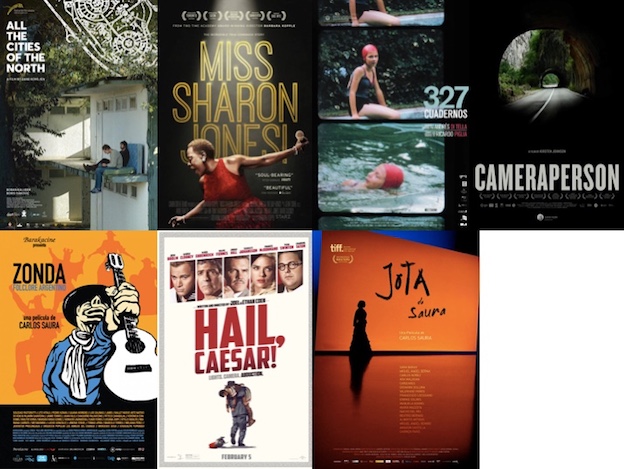
I watched Sumie García’s Relato familiar / Familiar Story (2017) and Marko Grba Singh‘s Stars of Gaomeigu (2017) [no poster available for the latter] on Festival Scope as part of the selection from Visions du Réel 2017 – the films (all are shorts or mid-lengthers) are free to view until 14th May. It’s worth checking the public (as opposed to professional) Festival Scope site fairly regularly as they have different collections available throughout each month (related to recent film festivals).
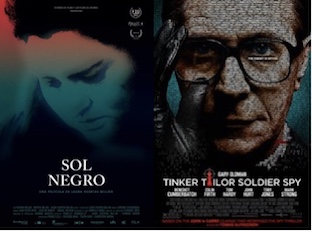
A quiet month for me, cinematically speaking. In the end I didn’t watch any of the FICUNAM films I mentioned last month – Sol negro (only 45 minutes long, so mid-length rather than a feature) was part of a collection of films from FICCI (Cartagena International Film Festival). Festival Scope currently has a selection of (free to view) documentaries from Cinéma du réel (available until 16th April). UPDATE (June 2017): Sol negro has been added to the Doc Alliance platform.
The only other thing I watched was a mini documentary series, Czech Film Avant-Garde (Libor Nemeškal, 2017) – subtitled and uploaded to YouTube by its writer/director. The individual episodes are each around 10 minutes.
If you subscribe to Mubi in the UK, I recommend Silence (Pat Collins, 2012). It was one of the first films that I reviewed for Eye for Film: ‘In the absence of a ‘proper’ narrative, Silence is difficult to define – like silence itself, it exists in the interstices, in this case between fiction and documentary, as a film about the search for an absence that is shaped by incontrovertible presence. But the film is well worth the effort of tuning into its wavelength.’
I’ve recently had cause to consider Iván Zulueta’s underground classic on two occasions – someone emailed me to ask whether I had any information on the availability of the film (this is the subtitled version I directed them towards), and I happened to spot that it will be screening in Manchester at ¡Viva! Spanish and Latin American Festival in April as part of their focus on films from the Transition. These two things led me to read over what I’d written about Arrebato on the old blog – it was one of my favourites of the films I wrote about there – and as a result I thought that I’d briefly suspend my break from blogging in order to revisit it here within my Reprint series. The original post (my 200th on the old blog) was written in December 2014 as my contribution to Shadowplay‘s annual event – The Late Show: Late Movie Blogathon – which focuses on films from the twilight of people’s careers. What follows below is a revised version of that piece. (Update, August 2017: where I’ve reprinted something here, I’ve decided to remove the contents of the original on the old blog and instead leave a link there to the new site (it doesn’t make much sense to have the pieces appear in two places) – however, in this instance, I have left the original to host the clip referred to further below because I have no way of transferring it).
Iván Zulueta’s career as a filmmaker was short – he made only two feature films – but if he is little-known outside of Spain, his influence is nonetheless far-reaching within subsequent generations of Spanish filmmakers. He had spent time in London and New York during the 1960s and 70s, and was strongly influenced by both the Carnaby Street vibe and psychedelia of the former and the underground filmmaking (specifically Warhol) and grubby aesthetic of the latter. His first feature – Un, dos, tres, al escondite inglés (1970) – was a pop musical about a group of music fans attempting to boycott a song contest (one that sounds similar to Eurovision), and is often described as taking inspiration from Richard Lester’s films with The Beatles. He made a multitude of abstract and experimental Super 8 films during the 1960s and 70s: a large proportion of them were either confiscated or lost, but several can be found online (they are all dialogue free – Frank Stein (1972), Masaje (1972), Aquarium (1975), En la ciudad (1976-77), A Malgam A (1976), and Leo es pardo (1976)). From the 1970s onwards he was also a film poster designer for a range of Spanish directors including José Luis Borau (his mentor), Manuel Gutiérrez Aragon, Luis Buñuel (Zulueta’s poster for Viridiana (1961) – a film the Franco regime declared didn’t exist – can be seen on the wall of José’s apartment in Arrebato) and Pedro Almodóvar (including one of my favourites, Entre tinieblas / Dark Habits), and also for the San Sebastián Film Festival (Zulueta’s father had been the Festival Director between 1957 and 1960). Zulueta made two further shorts – some ten years after Arrebato – but when he died in 2009 (at the age of 66), he had spent years in the wilderness in thrall to heroin addiction and a self-imposed exile in San Sebastián (his home city).
Given the emphasis placed on his visual focus by those interviewed in tribute programmes made after his death (almost everyone describes him as incredibly knowledgeable about all aspects of art and design, but someone who never read books), it is perhaps appropriate that my first experience of watching Arrebato was a copy with no subtitles and murky sound (one of El País‘s collection of DVDs): I clung to the images like a life raft.
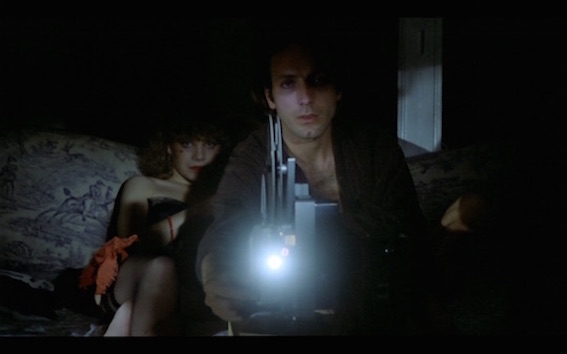
To summarise the plot: In the present (Madrid in the late 1970s), film director José Sirgado (Eusebio Poncela) returns home to find that his actress ex-girlfriend Ana (Cecilia Roth) – a heroin addict like himself – has returned to his apartment after several weeks of absence. In between arguing with Ana and sliding into a drugged oblivion, José starts listening to a recording – and eventually watching a film – sent by an old acquaintance, Pedro (Will More), a younger man who is obsessed with shooting film. A lot of the film plays out in flashback as the recording causes José to remember his first strange encounter with Pedro, and also their second meeting a year ago (when Ana was also present). In the last section of the film, José goes to Pedro’s apartment to try to solve the mystery contained within the recording and accompanying film.
I can usually get by without subtitles but here I think I would have struggled even with clearer sound because the script is full of gnomic utterances, and More’s delivery is deliberately strange (Pedro’s voice is usually exaggeratedly deep, but rises when he becomes excited or ‘enraptured’ and increasingly childlike) with large parts of the film conveyed via his voiceover. The desire to lose yourself in something (or someone) is a common enough impulse but in Arrebato this ecstasy is tinged with horror, suggesting that both cinema and drugs (the chosen routes into the sublime) are vampiric forces. The film is full of moments of beguiling but unsettling beauty (cinema as enchantment) in conjunction with a building sense of claustrophobia. The latter is generated via the film’s limited locations (José’s apartment during the course of that one night, the country house where he first meets Pedro, or the bedroom of Pedro’s Madrid apartment), the action frequently taking place in the shadows (faces usually illuminated by the flickering lights of projectors), and aurally through certain repetitive elements on the soundtrack (a recurring theme features the sound of children’s toys in an uneasy lullaby, but there’s also the insistent clicking of the timer on Pedro’s camera).
The film’s title refers to a state of being that the central trio – or at least the two men – are seeking. As Pedro explains it, what they are pursuing is that sense of being enraptured in something that we have as a child, when we could spend hours focussed on one thing and in our own little world. That an object is involved is important because for Pedro this state relies upon the act of looking, but all three of them also use drugs as their gateway into rapture. Zulueta described these symbolic items as “an object that condenses a whole series of things that have shaped you” [I’m assuming that this quote comes from one of the documentaries on the subtitled DVD – I didn’t note the source in the original post]. Pedro tests the (rare) people he meets by trying to find a) their special object, and b) how susceptible they are to being enraptured.
José’s object is an album of collectible stickers depicting scenes from King Solomon’s Mines (Compton Bennett and Andrew Marton, 1950) (from Zulueta’s own childhood collection), for Ana it is a Betty Boop doll, but for Pedro it is (or will be) his own Super 8 films. His sharing of his film collection during José’s first visit becomes a performance of grimaces and pained squeals as he hasn’t managed to capture the precise (but ephemeral) thing he is after. By José’s second visit – between which times José has sent the younger man a timer for his camera so that he can record his time-lapse images with more precision – Pedro has accomplished his filmmaking intentions as far as he can at home, and in the aftermath of the visit will set out into the world to capture new images. Much like José and Ana he will slide into a world of sex and drugs (the latter eventually curtailing the former), but Pedro’s dissatisfaction with those experiences leads him back into his cinematic obsession with an even greater intensity. At the point at which he sends the recording and film to José, he has come to believe that his Super 8 camera has taken on a life of its own, and is vampirically taking his life force from him while simultaneously allowing him to reach an ever-heightened state of rapture.
Even during my somewhat incomprehensible first viewing, the charisma and chemistry of the central trio was plain to see. Eusebio Poncela – already associated with nonconformist roles at this point – was the most experienced of the three, with a certain amount of blurring between life and art given his participation in the movida (a cultural phenomena in post-dictatorship Madrid; some of its key figures, including Zulueta, appear in Pedro’s Super 8 film of a party). Despite José’s uncertain disintegration (the vampire film he has just directed is turning into a disaster, his relationship with Ana is mutually-destructive, and he’s in a downward spiral with drugs), Poncela’s stillness is the calm centre around which the more volatile other two circulate. In the reunion documentary (included on the subtitled DVD – filmed in 1998 and therefore doesn’t feature Zulueta, who was in self-exile at that point) both Poncela and Will More state that their character is Zulueta’s alter-ego – more likely the two represent different aspects of the director. More was also part of the same social crowd and had appeared in one of Zulueta’s Super 8 short films; the role of Pedro was written specifically for him. By turns childlike and sinister, More’s performance is unsettling with deliberately exaggerated vocal tics and gestures, and a breathily insinuating style of delivery on the recording. More so than José or Ana, Pedro is someone on the margins by inclination rather than social circumstances (in terms of class and money he seems comfortably off, and unlike the other two he doesn’t work). Arrebato would be More’s only significant role – he accompanied Zulueta into heroin addiction and cuts a ravaged figure in recent footage.
Although the film is undoubtedly ‘about’ the men, Cecilia Roth is nonetheless equally memorable in what was her first substantial film role. She says during the reunion documentary that as the youngest member of the team (she was 23 at the time of filming, whereas her co-stars and director were in their 30s) she was worried about playing a character older than herself – a woman “with a past” as she describes it, whereas she feels that Arrebato was “the beginning of my own past”. Roth (like Poncela) obviously went on to significant roles with Almodóvar, but arguably she has never been as incandescent as she is in the sequence in Arrebato where she dresses as Betty Boop and sings along to the record player. It is an overt and conscious performance by Ana – she stands in front of the projector screen, with the light of the projector acting as a spotlight – and an attempt to win José back (although undercut, as I noticed on my second viewing, by the fact that the song she sings is the one that plays in the scene where he introduces her to heroin). She is so alive that she jolts the camera into movement – in the only travelling shot of the film, and possessing a dynamism that is otherwise only seen in Pedro’s films, the camera follows her as she dances towards José (the original post has a clip of the sequence at this point – I no longer have the file and haven’t been able to replicate it because VLC isn’t working for me). It’s a genuine ‘a star is born’ kind of sequence, in someways at odds with the rest of the film but perhaps all the more effective for that.
Arrebato‘s reputation as a film maudit was established from the outset. It was turned down by both Berlin and Cannes on the basis of its pro-drugs attitude (although that is arguably a matter of perception given that those onscreen are devoured by their addictions) and it had a limited release in Spain, sinking more or less without a trace. In the documentary Iván Z (Andrés Duque, 2003)* – a series of conversations with Zulueta, who by then was on methadone and attempting to reenter the film business (without success) – he says that he was burnt out after Arrebato but had known while he was making it that it would likely be his only chance. He is animated when discussing cinema (and his admiration for David Lynch) and very candid about his addictions, but falters when talking about his then-current situation (he was back living with his mother in the house he was born in and likens it to The Exterminating Angel (Luis Buñuel, 1962) – the sensation of being stuck in the same place but not knowing how to get out). A sense of loss accumulates in the recurring assertions of his former colleagues that he was a genuinely exceptional talent, and a unique figure in Spanish cinema, who could have had an international career.
The influence of his second feature film however has had a far greater reach than one might suppose for a film that never had a proper theatrical release (and belies the ‘cult’ label that is often attached to it). Pedro Almodóvar is the most obvious (and possibly facile) example. He was a near contemporary (his voice appears in Arrebato – he dubbed Helena Fernán Gómez) and his 1980s films share certain aspects of Zulueta’s aesthetic style (and indeed most of Arrebato‘s cast). But there’s a freshness to Arrebato that survives, and its influence lives on more than thirty years later. My first viewing of the film was just a couple of weeks before I saw El Futuro (Luis López Carrasco, 2013) at the Bradford International Film Festival in April 2014, and it’s a clear point of reference for the latter (confirmed by the director in this interview).
Arguably Arrebato‘s current reputation within Spain means that it is now part of the acknowledged pantheon of Spanish cinema; in 2016, when the film magazine Caimán cuadernos de cine surveyed 350 film writers (critics, journalists, festival programmers, film historians, academics – no filmmakers were asked) to create a top 100 Spanish films, Arrebato occupied 5th place (ahead of it were Viridiana (Luis Buñuel, 1961), El espíritu de la colmena / The Spirit of the Beehive (Víctor Erice, 1973), El verdugo / The Executioner (Luis García Berlanga, 1963), and Plácido (Luis García Berlanga, 1961)). Writing in 2002, and arguing that the film deserved better than to be fetishised with the label ‘cult’, critic Ángel Fernández-Santos summarised Zulueta’s film thus:
Arrebato is a dark instance of pessimism. It is intricate cinema, unfathomable at some points of its crooked and tumultuous journey. And it is, above all, cinema in a raw state, disturbing, painful and great, that situates us with rare elegance in front of a vigorous and devastating image of the dissolution of conscience and the search for death. The film was conceived and built – in a long and bumpy creative process – by a complex and refined filmmaker, a one-off, gifted as few are to perceive and express feelings of desolation and despair. [my translation – the original is here]
So not exactly a laugh riot, and it won’t be everyone’s cup of tea. But it stayed with me for the seven months between my first viewing and when I tracked down a subtitled version in order to write about it for Shadowplay’s blogathon (the fact that I kept thinking about it was part of the reason I decided to write about it in that context). My second viewing – with the luxury of subtitles to clarify some things (but not everything) – elevated it further in my consideration, and underlined the sense that Zulueta’s subsequent disappearance was a loss for cinema. Arrebato is a haunting film, one that gets under your skin. If you get the opportunity to see it, whether on DVD or at a festival screening, take it.
*Iván Z is also included on the subtitled DVD, but can be found on YouTube with subtitles – I particularly recommend it because aside from showing Zulueta talking lucidly about himself, rather than his being filtered through other people, it also features examples of his paintings, illustrations and film posters (some of them are stunning).
Plus, Mining Poems or Odes (Callum Rice, 2016) [a short film – free to view on Vimeo].
I’ve decided that I should continue watching films for the Carlos Saura Challenge even if I’m not currently writing (this may mean that I end up reshaping the project, but I’ll cross that bridge later – better to persevere in some form than give it up), hence my watching his two most recent films.
While I’m taking a break from writing, I’m going to log what I’ve watched each month. In addition to the features above, I also watched this collection of animated shorts (free to view until 13th February).











 Nobody Knows Anybody