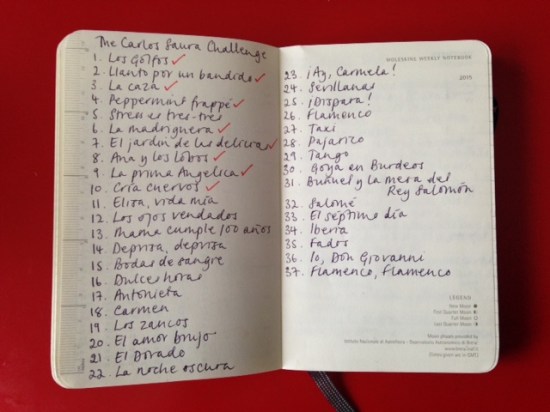
The Carlos Saura Challenge began in February 2013 as a way of addressing a gap in my knowledge of Spanish cinema; I was familiar with Cría cuervos and the dance films, but I hadn’t seen any of the other films from Saura’s substantial career. I have made intermittent progress – my initial aim of watching all 37 of his films in the space of a year proved to be wildly unrealistic, but my viewings ground to a halt for months at a time on several occasions. Attempting to watch them chronologically was possibly a mistake – although you can see themes developing by considering them in that order – and in fact I have ended up looping back a couple of times because earlier films that were unavailable suddenly appeared on VOD or another format (his directorial debut – Los golfos / The Delinquents – was shown on 35mm as part of the Viva! film festival in Manchester in early 2014).
 I have been surprised by how much I like his early films. Through necessity (to avoid the censor during the dictatorship) many of the early films are metaphorical – which can be something that I find irritating – but whereas I had been under the impression that Saura made very dry and dour films in that period, I found a mischievous sense of humour and someone who (along with producer Elías Querejeta, with whom he made a run of 13 films starting with La caza / The Hunt in 1966) had clearly done his damnedest to foil those who were restricting what could be put on Spanish screens. Censors often failed to appreciate that suggestion can be more powerful and more resonant than a direct depiction. There are also some great performances from José Luis López Vázquez (who I had previously only seen in comedic roles) and Geraldine Chaplin (a revelation) in those early films, most of them probably little known outside of Spain because they haven’t been commercially available in subtitled form (most of the DVDs that I have tracked down do not have subtitles).
 I restarted again in January this year with Cría cuervos (the status of which had been putting me off writing about it) and then went backwards to watch La madriguera / Honeycomb. And then I stopped again. So basically I’ve reached the 1970s, I am 10 films into his career (barely a quarter of the way through his total filmography) and currently in a run of films where Geraldine Chaplin gets put through the mill (I’ve got 3 more films to go before they romantically and professionally parted company from what is an actor-director partnership – they made 8 films together – that merits greater critical attention). Next up will be Elisa, vida mía / Elisa, My Life with Chaplin and Fernando Rey – I’m going to aim to cover that at some point during September.

I’m going to recap the films I’ve written about so far (and link to where I’ve written about them) and list the ones still to come. I usually list things Spanish title / English title the first time I refer to them – if the English title is in square brackets, it’s a literal translation as there is no official English language title. If a title in the list below has ‘VOD’ next to it that means that VOD is currently the only way to view it (click on ‘VOD’ to be taken to where it’s available – Filmin subscriptions can only be purchased within Spain but Filmotech allows you to pay 7€ for a month and watch almost anything on the site), ‘+VOD’ signifies that means that it is also in circulation on DVD, and nothing next to the title means DVD only (many of them are OOP but I’ve indicated if a film is completely unavailable – i.e. no DVD that I’m aware of). Cría cuervos, Blood Wedding, Carmen, El amor brujo, and Tango all have UK DVDs available. The majority of the other films were OOP but Enrique Cerezo’s current crusade to make Spanish cinema classics more readily available (Spanish DVDs always seem to have very limited runs and some disappear very quickly – I acquired most of my Saura DVDs secondhand) means that a few of the Saura/Querejeta collaborations (and some of the director’s later films including El Dorado and ¡Ay, Carmela!) are now available on DVD and Bluray in restored, no-frills editions (no English subtitles as far as I know) through the Divisa label.
01. Los golfos / The Delinquents (1962) [French DVD only] +VOD. Saura’s directorial debut but one that I saw out of sequence because it had long been unavailable in any format. A French DVD (with French subs only) was released in 2013 but I had the chance to see the film on 35mm at Viva! Spanish and Latin American Film Festival in Manchester in 2014 – to date it is the only one of Saura’s films that I have seen on the big screen.
02. Llanto por un bandido / Lament for a Bandit (1964). Heavily censored at the time of its original release, the version I’ve seen suffers from the censor’s interventions. A lesser film in Saura’s filmography although – as with Los golfos – there are already certain elements that will recur throughout his career. It also contains Francisco (Paco) Rabal on scenery-chewing form, Lino Ventura, and a cameo by Luis Buñuel.
03. La caza / The Hunt (1966) +VOD (VOD includes an English subtitle option). Saura’s first masterpiece.
04. Peppermint frappé (1967) +VOD. The most Almodóvarian of Saura’s films (predating the man from La Mancha by several decades) and the first of his collaborations with Geraldine Chaplin (who here plays three women) and José Luis López Vázquez.
05. Stress-es tres-tres / Stress is Three (1968) [unavailable]
06. La madriguera / Honeycomb (1969) VOD. Chaplin again takes on multiple personalities in this blurring of performance, role play, dreams, and reality.
07. El jardin de las delicias / The Garden of Delights (1970). The blurring of dream and reality seen in La madriguera is kicked up a notch in this darkly funny (with a brilliant performance by López Vázquez) and structurally complicated film – the complex intricacy of the structure acted as a smokescreen to distract the censor from some of the more political elements.
08. Ana y los lobos / Ana and the Wolves (1973) +VOD. Chaplin stars alongside Fernando Fernán Gómez in a film where a sense of uneasy foreboding builds to a dark and horrific payoff.
09. La prima Angélica / Cousin Angelica (1974) +VOD. This is probably López Vázquez’s best performance for Saura (although he is never less than great across all of their collaborations) and it is my favourite of the films I’ve watched so far – it deserves to be better known outside of Spain.
10. Cría cuervos / Raise Ravens (1976) +VOD. Probably the director’s best-known film in the UK. Fiona Noble also wrote a guest post about it for the old site.
Still to come…
11. Elisa, vida mía / Elisa, My Life (1977) +VOD (VOD includes an English subtitle option).
12. Los ojos vendados / Blindfolded Eyes (1978) VOD.
13. Mamá cumple 100 años / [Mama Turns 100] (1979).
14. Deprisa, deprisa / Faster, Faster (1981) +VOD.
15. Bodas de sangre / Blood Wedding (1981).
16. Dulces horas / [Sweet Hours] (1982) [unavailable].
17. Antonieta (1982) [French DVD only].
18. Carmen (1983).
19. Los zancos / [The Stilts] (1984).
20. El amor brujo (1986).
21. El Dorado (1988) +VOD.
22. La noche oscura / [The Dark Night] (1989).
23. ¡Ay, Carmela! (1990) +VOD.
24. Sevillanas (1992).
25. ¡Dispara! / Outrage (1993).
26. Flamenco (1995).
27. Taxi (1996).
28. Pajarico / [Little Bird] (1997).
29. Tango (1998) +VOD.
30. Goya en Burdeos / Goya in Bordeaux (1999) +VOD.
31. Buñuel y la mesa del rey Salomón / Buñuel and King Solomon’s Table (2001).
32. Salomé (2002).
33. El séptimo día / The Seventh Day (2004) +VOD.
34. Iberia (2005) +VOD.
35. Fados (2007).
36. Io, Don Giovanni / I, Don Giovanni (2010).
37. Flamenco, Flamenco (2010) +VOD.
38. Argentina (2015) [due to premiere at the Venice Film Festival].




 Nobody Knows Anybody