Postcard from Gijón: Days 3-4

Version 2


Sunday being a day of rest, it was only appropriate that I should catch up on some sleep (and also write the first of these postcards) – so the first film of the day for me wasn’t until 5pm.

Land of Mine_01
Under Sandet / Land of Mine (Martin Zandvliet, 2015) – one of the Official Selection (competition) titles – is a Danish-German co-production that tells a little-known story from the aftermath of World War 2, namely that German soldiers were used to clear mine fields in countries that had been under Nazi occupation during the war. Some two million mines had been laid along Denmark’s western coast (someone apparently thought that it was a possible site for the Allied landings that would in reality occur in Normandy) presenting an obvious danger to the civilian population. 2,600 German troops (most of them teenagers recruited in the dying days of the war) were put to work defusing and removing the mines, having been told that they would only be allowed to go home to Germany once every mine had been recovered. The film gives two points of view: Sargent Carl Leopold Rasmussen (Roland Møller), an experienced Danish officer who is overtly and openly hostile towards the German forces who occupied his country (the English title obviously has the double meaning of ‘my land’ and ‘minefields’); and the young German soldiers (most notably Louis Hofmann, Emil Belton and Oskar Belton – the latter two play the team’s youngest members, a pair of twins who are barely in their teens) who he must train as a bomb disposal unit. If the treatment of what is an interesting story perhaps leans towards the conventional (the narrative arcs of certain characters is telegraphed from early on and although there are several sequences of high tension in relation to the bombs, that tension cannot be sustained for the duration (that said, I jumped in my seat at least three times)), the acting is great (a lot of it communicated silently through gesture and expression) and the characters are differentiated sufficiently for us to become invested in what happens to them as individuals.
In the Crosswind
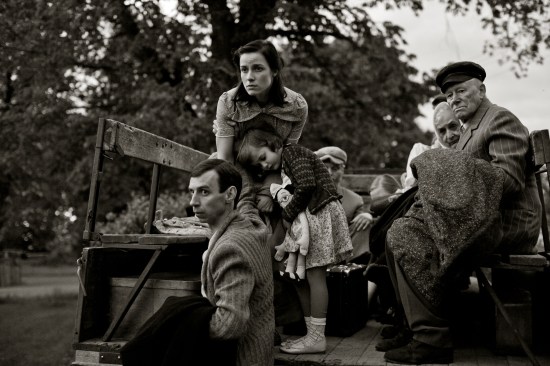
The second film screening from the Convergencias selection was Risttuules / In the Crosswind (Martti Helde, 2014) – chosen by David Tejero (you can read his text on the film, here). I think that this will end up being my favourite of the festival (unless something astounding comes along) because it is utterly original in form and visualisation, and emotionally devastating – in contrast to the majority of screenings where people start chatting and filing out during the end credits, in this case you could have heard a pin drop and barely anyone got up from their seat until the credits had ended. This is another film that tells a little-known story in relation to World War 2: Stalin’s ethnic cleansing of the Baltic states from the early 1940s onwards involved thousands of citizens from Estonia, Lithuania, and Latvia being forcibly sent by train to remote outposts in Siberia. Their predicament continued after the war ended and most were unable to return to their homelands until some time after Stalin’s death in 1953.
In the Crosswind tells the story via a series of letters (heard in voiceover – there is no spoken dialogue in the film) based on those written by Erna Tamm (played by Laura Petersen) as if to her husband Heldur (Tarmo Song) after they were separated during the removals. But the most arresting feature are the black and white tableaux vivants through which Helde conveys those moments when time stands still for us at those junctures when our lives are irrevocably changed. People stand stock still, emotion frozen on their faces, captured in moments of rupture and turmoil. The camera moves through a given scene in one continuous take (as far as I recall) – with the sound continuing as if everything were in action – and the staging is ingeniously blocked-out in such as way so that the movement of the camera through the tableaux allows a set up to change without cutting. The best example of this is a sequence where the camera is moving through an interior and passes a series of windows with pillars of wall in between them – the camera keeps slowly moving and each time we see the view out of the window, the (frozen) action has moved on, telling a violent and horrific story. The effect is a bit like looking at individual frames – or still images – taken in succession. It is genuinely unlike anything I’ve seen before and I hope that I can see it again.
Nelson
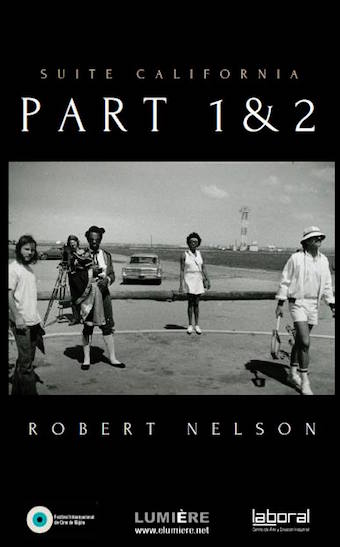
My last screening on Sunday was one of the FICXLab (experimental) sessions showing two films by Robert Nelson: Suite California & Stops Passes Part 1: Tijuana to Hollywood via Death Valley (1978) and Suite California & Stops Passes Part 2: San Francisco to Sierra Nevadas & Back Again (1978). I found the combination of sound and image to be quite discombobulating. Part 1 features a spoof of the narcotrafficante ‘genre’ border crossings and there is humour throughout, usually via the juxtaposition of sound and image, but what emerges across both parts is multi-faceted portrait of California. The recourse to historical facts and monuments – giving a kind of historical layer to the presentation of landscape and place – reminded me of James Benning’s Deseret (although in visual terms they are quite different, as is Nelson’s focus on people within the spaces he explores).

The Sky Trembles

Monday started with The Sky Trembles and the Earth Is Afraid and the Two Eyes Are Not Brothers (Ben Rivers, 2015), another discombobulating film and I still don’t know quite what to make of it. It starts as a ‘making-of’-style documentary, showing Spanish director Oliver Laxe making his new film, Las Mimosas, in Morocco. The press kit probably has the best synopsis of what happens: ‘Shooting against the staggering beauty of the Moroccan landscape, from the rugged terrain of the Atlas Mountains to the stark and surreal emptiness of the Moroccan Sahara, with its encroaching sands and abandoned film sets, a director abandons his film set descending into a hallucinatory, perilous adventure of cruelty, madness and malevolence. A Paul Bowles story combined with observational footage forms a multi-layered excavation into the illusion of cinema itself’. My response to a film immediately after seeing it is usually a reaction – that is to say emotional rather than intellectual – and I only really start to form a coherent opinion when I begin writing. In this case, I think that I need to watch it again because my response feels like it’s stuck in reaction to the visuals (very beautiful and eerily strange) rather than engaging with what is going on at a deeper level. One to return to at a later date.
Transatlantique_03
Next up was my chosen film for Convergencias – Transatlantique (Félix Dufour-Laperrière, 2014). This was the first time that I’ve introduced a film at a festival (or anywhere else other than a university) and led the subsequent Q&A, but my nerves were mainly about doing it in Spanish and making myself comprehensible to the audience (Félix spoke in French, which was then translated into Spanish by a translator). The original text that I had to submit as a proposal was almost 1,000 words but this then had to be edited and rewritten into a 200 word version for the festival catalogue:

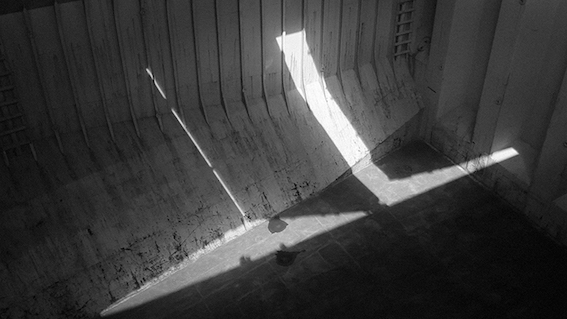
‘Part meditative travelogue and part wordless maritime reverie, Transatlantique unfolds in the spaces of a cargo ship undergoing a transatlantic voyage between Antwerp and Montreal. The black and white cinematography registers the inkiest of blacks and blinding whiteness in the Atlantic’s unruly seascapes and, as the swaying motion of the ship causes a chiaroscuro dance on its surfaces, a complexly layered soundscape combines the sounds of the crew with audible elements of the ship and the encompassing sounds of the sea and wind in an evocative and transportive symphony.
This essay film is part of the trend for immersive documentaries, but its singularity resides in its relationship with the new silent cinema and the manner in which the film only offers a narrative in the sense that it begins in one place and ends in another; it is a stream of consciousness representation of the journey and the lives of those onboard rendered in an elegant and idiosyncratic visual form. It is fitting that a film exploring a ship at sea – an in-between space and no-man’s land in the interstices between national borders – uses the universal language of cinema at its most elemental to communicate with the audience.’

It was great to see the film on the big screen as my original viewing was on a computer (as I’ve said previously, I wasn’t able to see it in Edinburgh). Seeing it on that scale made certain things visible. David Cairns wrote about the film during EIFF and he mentioned ‘a breathtaking shot of the sea, blackly luminous’ and wondered whether it was played in negative – watching it for the second time, on a larger scale, and having recently seen Noite sem distancia (Lois Patiño, 2015), it seemed to me that the image was indeed one from elsewhere in the film flipped into negative. Someone asked about it during the Q&A and Félix confirmed that that was the case but that he had also digitally cut part of the image so as to remove the horizon line. I’ll be presenting the film again on Thursday.

Dorsky et al
I returned to the FICXLab screen for the last session on Monday, this time for a programme of shorts by Nathaniel Dorsky, Helga Fanderl, and Jonathan Schwartz. I’ve not seen any of their work before, so I didn’t really know what to expect. The programme was split into two, with Dorsky and Fanderl in the first half and then Schwartz in the second because the work of the first two complement each other whereas Schwartz’s films are quite different. The (silent) films by Dorsky (Prelude (2015) and Intimations (2015)) and Fanderl (Communing (2015)) have images of the natural world, repetition, reflection, and an emphasis on patterns of light and shadow in common (although the treatments are different), while Schwartz’s (a set of miniatures (2015), animals moving to the sound of a drum (2013), 3 1/33 series side a (2005-10), if the war continues (2012), 3 1/33 series side b (2005-10), Happy Birthday (2010)) utilise sound and the duplication of images to create worlds in miniature. My favourite of the evening was Fanderl’s film, although again my reaction was one of sensation rather than thought – but I’d like to see more of her films (which are shot on 16mm Super 8 and edited in camera). I will be writing a report for Desistfilm about the experimental section, so I won’t expand on these films any further for the time being.

To be continued…
Postcard from Gijón: Days 1-2

IMG_1655

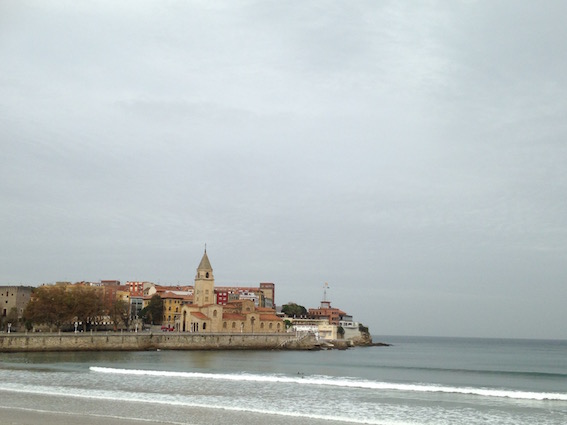
I had a slow start to the festival on Friday in part because my day started so ridiculously early (I was at the airport at 5am) that I hit a brick wall of fatigue by mid-afternoon. I’ve not had the chance to properly explore yet – I had a wander around to find the main screens on Friday afternoon and in the process found the seafront, but I’m intending to go further afield during the coming week.
So my first event on Friday was the opening gala, presented by Carlos Areces in his own inimitable style. In addition to presenting the various sections of the festival, the opening gala is the occasion for the presentation of “career achievement”-type awards. One of these is the ‘Mujer de Cine’ [Woman of Cinema] award, which is intended to raise the profile of – and give recognition to – women working in the film industry. In this instance the award went to Kristina Bayona, a renowned casting agent and actors’ representative (she discovered Jordí Mollà (who sent a video message) and Penélope Cruz – and is still the agent of the latter as well as a host of high profile Spanish actors, including Elena Anaya (who presented the award)). The other main award is the Premio Nacho Martínez (Nacho Martínez award, named after the late Asturian actor), which was given to José Sacristán. It was impressive not only to see the career montage – and how many key Spanish films he has appeared in (illustrating what I said in my preview, that he has ‘effectively incarnated, performed and subverted Spain’s changing society across more than half a century’) – but also to hear that great gravelly voice in person.

La calle de la Amargura
The opening film was Arturo Ripstein’s La calle de la Amargura (which imdb lists as having the English title ‘Bleak Street‘ but I don’t think I’ve seen it referred to by that title anywhere else). I haven’t seen any of Ripstein’s many films and only know of his work by reputation, so I don’t know how this new film fits within a career that stretches all the way back to the 1960s. Based on real events – two prostitutes, intending to drug and rob their clients, accidentally killed two famous ‘lilliputian’ [the preferred term of the two characters in question] wrestlers when they gave them the same dose as meant for a full-size male – the film (written by Paz Alicia Garciadiego, Ripstein’s frequent collaborator) chronicles the circumstances in which the events played out in a tale of degradation, humiliation and poverty. Shot in black and white, the film visually recalls classic film noir (the shadows of alleyways and stairwells are utilised to great atmospheric effect – in fact stairwells and stairway landings are key transitional spaces within the film, places where exchanges (of all sorts) happen and part of the film’s emphasis on community) but with an almost Shakespearean dimension of tragedy wrought through wretched desperation and the attendant levels of melodrama that that implies. There’s no small amount of grotesquery but the characters aren’t judged – each has their reasons for behaving as they do and each is shown to be capable of acting out of love. It’s not really my sort of film but it’s well made and I’d be interested in seeing some more of Ripstein’s films in order to put it into some sort of context.

La delgada linea amarilla
Day 2 started with another Mexican film – but a very different vision of Mexico – La delgada línea amarilla / The Thin Yellow Line (Celso García, 2015). A gentle road movie that – much like the job undertaken by the characters – sticks to the line it starts off on and never wavers: it’s the sort of drama where the characters go on a journey in more than one sense. But Damián Alcázar is great in the lead role as a man who has lost something of himself over the years but is striving for dignity through work. Something about it reminded me of The Wizard of Oz (probably that yellow line they’re painting on the road and the way in which each of the gang has to ‘fix’ a missing / defective part of themselves) but I think that’s more down to my warped consciousness than any deliberate frame of reference. I won’t say any more about it as I’m intending to review it.

Poster_Hitchcock:Truffaut
Next up was Hitchcock / Truffaut (Kent Jones, 2015), which I found enthralling and could easily have watched at double the length. It examines the impact of the interviews Francois Truffaut conducted with Alfred Hitchcock across eight days in 1962, both in terms of how they changed perceptions of Hitchcock (who up until this point was generally viewed as an entertainer rather than a serious auteur because of the genres he worked within) but also how the subsequent book (published in 1966) influenced subsequent generations of directors. A series of very articulate directors such as David Fincher, Martin Scorsese, and James Gray discuss how the book – in which the text is accompanied by stills, effectively giving a breakdown of editing patterns and what effects Hitchcock was achieving through his choices and style – opened their eyes to the methods behind filmmaking, and inspired some of them into their careers. My one criticism of the film is that no women are interviewed – although off the top of my head I can’t think of a female director who seems obviously influenced by the Master of Suspense, I’m sure that his films inspire filmmakers irrespective of gender and it should be possible to reflect that in terms of interviewees. Impressively film writer Kent Jones effectively translates the book into audiovisual form – we hear the recordings of the interviews in combination with the text in the book (with key phrases highlighted) and the relevant sequences from the films under discussion. The result is a celebration of cinephilia (both Truffaut’s and that of the contemporary directors), of Hitchcock and Truffaut and their art form, and a fascinating dissection of the films. It has made me want to re-read the book (it’s probably more than ten years since I last looked at it) and to (re)watch Hitchcock’s work in parallel. I would also really like to watch Jones’ film again – so hopefully it will get a UK release.

Krisha
I also went to the first of the selections of Asturian films, in this case a programme of shorts – but I am going to see several of the shorts selections, so I will return to the eight I saw yesterday when I have seen more of the others. Therefore my final film of the day was the first of the Convergencias films – Krisha (Trey Edward Shults, 2015), chosen by Carlota Moseguí (you can read Carlota’s text on the film – here). Thanksgiving family reunions in American cinema are often the sites of recrimination and disaster – Krisha fits within that tradition but it presents the mental disintegration of the eponymous character in such a way as to put us inside her experience. Camera movement, alterations of tempo and light, and a layered soundscape (with varying volume) all coincide to knock us off kilter in parallel with Krisha as events and interactions become too much for her to cope with, causing a sense of dread and impending doom to build almost from the outset of the film and her arrival at her sister’s house. Likewise the aspect ratio changes in stages to reflect Krisha’s perception of things closing in on her. Inspired by an event within the director’s own family – and with some family members playing a version of themselves (including Krisha, who is Trey Edward Shults’ aunt) in a fictionalised recreation of a traumatic rupture in their family – this is an impressive directorial debut by a filmmaker who seems to be in complete control of the story that he wants to tell and the way that he wants to tell it (in marked contrast to his protagonist). Another film that I would be happy to watch again sooner rather than later.

To be continued…

FICX53: Convergencias

Convergencias_posters

Back in June I saw the following call for papers/proposals from the Festival Internacional de Cine de Gijón:

‘[Asociación Cultural Convergencias de la Crítica Cinematográfica] and the Gijon International Film Festival will be hosting a second edition of its critics’ strand: CONVERGENCES. This strand intends to become an opportunity for film critics all over Europe – a meeting point of discussion for a diverse and wide-ranging spectrum of cinephilia. In order to realise this in FICXixon, we are organising a call for papers. The aim is to select six films not previously shown in Spain. This strand is conceived as a place for discovery and recognition of directors who have not received the appropriate attention of Spanish programmers and curators. We encourage critics to participate by sending proposals of films to programme at FICXixon. The first edition of this strand was a great success, working as a meeting place for Spanish film critics, that presented the selection to over 1,200 spectators. This year, we would like to open this participation to our European colleagues.’

A critic could participate if they were frequently publishing articles or discussing film on TV or radio. You had to submit a CV and a covering letter as part of the proposal to explain why you were interested in taking part. The film proposal itself had a word limit of 1,000 words in either English or Spanish – within the conditions set out (a film produced between 2014 – 2015, preferably one that had not yet been shown in Spain, and relevant to contemporary trends / delivering fresh ideas for the evolution of film language), you had to make the case for the importance of your chosen film and why it should be included in the festival’s programme. The final choice would be made by the section’s coordinators, Martín Cuesta (Cinema ad hoc) and Víctor Paz (A cuarta parede).
I wasn’t sure that I published frequently enough to qualify because I tend to have bursts of activity when I go to festivals followed by slow periods when I watch more than I write. But I knew that I had various upcoming festivals in September and early October (I didn’t know that I’d get derailed by the brouhaha over at the old blog during August) and I thought that it was worth going for given that they specifically stated that ‘only the quality and depth of the several points developed in the texts will be taken into account, no matter what the previous experience of the film critic is’. That seemed like an admirably open door and to be worth the effort of applying. But what film to choose?
At that point in the year, the only festivals I’d been to were in Barcelona and Edinburgh – obviously anything I’d seen in the former had already been shown in Spain, so that was a dead end. There wasn’t a great deal in Edinburgh that fitted the bill either (incidentally, it can be quite a faff to work out which countries a film has screened in). I was giving this proper thought while I was in Edinburgh, and looking through the festival catalogue there seemed to be two films that might fit the bill – films that were unusual enough that I’d probably be the only person suggesting them but that also sounded like my kind of film (liking the film wasn’t one of the conditions – but I would struggle to argue for a film that I didn’t actually rate). Anyway, I saw one of them but wasn’t bowled over by it. The other one – Transatlantique (Félix Dufour-Laperrière, 2014) – wasn’t screening until after I was leaving Edinburgh but it was in the videotheque so I headed there to watch it, only to be stymied by the fact that there was something noisy going on in the next room and this had been described as a silent film (which isn’t entirely accurate but it’s certainly a quiet film). So I bailed on that plan. In the end I watched it on Festival Scope….and I found it to be a singular and mesmerising film. So I wrote a proposal about it.
All of which is a very longwinded way of saying that I was one of the six critics chosen – Transatlantique is screening at FIXC53 with its director in attendance, and the festival is paying for my flights and accommodation so that I can be there too. I’ll get to meet the other chosen critics and discuss the films with them. I’m really thrilled to be taking part and to be meeting the other participants, and I’m intrigued by the other Convergencias films, none of which I’ve seen before (I’m also really looking forward to seeing Transatlantique on a big screen because it is visually stunning in a way that a computer screen cannot do justice to).
I will return to Transatlantique on here is some form, but I thought that I’d give a brief outline of each of the films in the section. The festival’s press release about the chosen films says that they’re connected through the use of sound in a creative capacity as a narrative element and through an expressive use of silence – I shall find out more when I watch them, but I can already see other potential overlaps in the descriptions below.

André's Eyes

André’s Eyes / Os Olhos de André (António Borges Correia, 2015) – chosen by Jesús Choya.
Trailer
Synopsis: An experimental docudrama in which the actual family members themselves participate in the recreation of their own story. Set in a small village in the Portuguese countryside, the film follows the struggle of a divorced father to keep his family together after his youngest son is taken away from them and placed in a foster family.

In the Crosswind

In the Crosswinds / Risttuules (Martti Helde, 2014) – chosen by David Tejero.
Trailer
Synopsis: In a series of black and white tableaux vivants, the film tells the story of an Estonian woman and her young daughter struggling to find their way home after being deported to Siberia by the Soviet occupiers in 1941. The imagery looks fable-like, and the detailed description on the TIFF website says that ‘carving out an uncanny space between motion and stasis, these images evoke a state in which the past seems solid and the present like a dream’.

Krisha

Krisha (Trey Edward Shults, 2015) – chosen by Carlota Moseguí.
Synopsis (taken from the official website): ‘Following a prolonged battle with addiction and self-destruction, Krisha, the black sheep of the family she abandoned, returns for a holiday celebration. But what begins as a moving testament to the family’s capacity to forgive soon spirals into a deluge of emotional bloodletting, as old wounds are torn open, and resentments are laid bare’. The cast includes several members of the director’s family.

The Road

The Road (Rana Salem, 2015) – chosen by Eduardo Guillot [not on Twitter].
Trailer
Synopsis: Rana and Guy, a young married couple, live in today’s city of Beirut. Drifting away from reality with no sense of time and space, Rana is trapped in memories and dreams. Guy decides that they must go on a trip. The director says that ‘the film is inspired by my life with my partner, but the characters are not us, even though we’re the actors. The Road is a very personal project, and it takes a look into how it is to be in love and maintain a long relationship in a country where it’s difficult to make long term plans due to its instability’.

Test

Test (Aleksandr Kott, 2014) – chosen by Pablo González-Taboada.
Trailer
Synopsis: Test is a story about the first nuclear bomb test which was conducted in Semipalatinsk in 1949. Director Aleksandr Kott has said of his dialogue-free film that “…have you noticed that when somebody is really close to you, you don’t need many words to communicate, you communicate with glances, gestures, and actions. Sometimes silent communication means much more than empty conversations. This film is for those who love looking, for those who remember that the cinema is, before all, an image. And when cinema was invented, it was without words.”

Transatlantique_11

Transatlantique (Félix Dufour-Laperrière, 2014) – chosen by me.
Trailer
Part meditative travelogue and part maritime reverie, Transatlantique is a black and white essay film – without dialogue – exploring the spaces of a cargo ship undergoing a transatlantic voyage. The brothers Félix (director, screenwriter, cinematographer, editor), Nicolas (co-cinematographer) and Gabriel Dufour-Laperrière (sound recordist) boarded the Federal Rideau in Antwerp and embarked on a 30-day journey to Montreal. The film is as interested in the architectural spaces of the ship as it is with the sea and its depths, and makes interesting use of sound…but that is all I shall say for the time being.

There is also a Convergencias video presentation by Martín Cuesta – here.

Preview: Festival Internacional de Cine de Gijón 2015

Gijón_poster

The 53rd Festival Internacional de Cine de Gijón runs between the 20th and 28th November in the coastal city in north west Spain. It has a massive selection of films with all sorts of interesting events and collections woven through the programme. I have summarised the line-up in a preview/overview at Eye for Filmhere.

I am heading to Gijón at the end of this week and will be participating in the critics’ section – Convergencias [Convergences] – for which critics had to propose a kind of ‘hidden gem’ film, or one that might not ordinarily come to the attention of the public. I’m going to write about that in a separate post.

The Fallen Idol (Carol Reed, 1948)

Fallen Idol01

In the post-war 1940s, Carol Reed made a set of films that should be the envy of any filmmaker (in fact it’s slightly mindblowing that they were released in consecutive years – how many runs like that are there?) – Odd Man Out (1947), The Fallen Idol (1948), and The Third Man (1949).

Sandwiched between two acknowledged classics, The Fallen Idol has perhaps not had as much attention but it contains many of the elements that characterised Reed’s filmmaking. It has been restored and re-issued on DVD/Blu-Ray in the UK today and I’ve reviewed it for Eye for Filmhere.

Crumbs (Miguel Llansó, 2015)

01_Crumbs

This is another film seen earlier in the year in a festival context – D’A Festival in Barcelona – and it’s one of my favourite films of 2015. I’ve spotted that it’s getting a US release today but it’s also going to be at Leeds Film Festival next month (ticket details can be found here).

I wrote about the film in the aftermath of going to Barcelona. My review of Crumbs (*****) is over at Eye for Film (here – fair warning: I’ve probably included too many plot details, so maybe hold off reading it until you’ve seen the film), where you can also find the interview I did with director Miguel Llansó (Part 1 and Part 2). I hope to revisit the film before the year is over – when I do, I will write a bit more about it on here.

Crimson Peak (Guillermo del Toro, 2015)

Crimson Peak_Chastain

It’s rare that I see a film on its opening weekend – unless it’s a limited release that may not stick around – but I belatedly realised that I was unlikely to get to Crimson Peak next week, so I went this morning. My review is now up at Eye for Filmhere.

I’ve stuck to the bare bones in terms of plot details and have tried to avoid any spoilers – I generally don’t read reviews before I’ve seen a film, but I wouldn’t want to spoil it for anyone who does read them first. As the review indicates, I felt that there was something missing from the film but I’m still pondering what exactly that was; I may return to it on here when more people have seen it so that I can go into more detail. But I think that it’s highly unlikely that Guillermo del Toro will ever make a film that isn’t worth seeing (and I’m certainly intending to rewatch this one in the future) – so go see!

Festival Report: Curtocircuíto

Volontè

As I’ve already said, I didn’t manage to go to Santiago de Compostela for Curtocircuíto but the festival gave me access to most of the films in the competitive categories. Besides the films that I reviewed for Eye for Film (and some films that I saw in Edinburgh earlier this year – Scrapbook (Mike Hoolboom, 2015), I Am a Spy (Sarah Wood, 2015), and Sound of a Million Insects, Light of a Thousand Stars (Tomonari Nishikawa, 2014)), the standouts for me included World of Tomorrow (Don Hertzfeldt, 2015) [which is available to rent on Vimeo], The Liquid Casket / Wilderness of Mirrors (Paul Clipson, 2014), Embargo (Johann Lurf, 2014), Paisaje con perro roto / Landscape With Broken Dog (Orazio Leogrande, 2014), Tehran-Geles (Arash Nassiri, 2014), Descubrimiento de Américo / Discovery of Américo (Miguel Mariño, 2014), and Historia Cerebro / Brain Story (Borja Santomé, 2015).

The latter two films were part of a collection of Galician shorts and given that I’ve been considering the Novo Cinema Galego recently, I decided to focus my festival report on films from that section – my report can be found at Eye for Film. I specifically focussed on Cruz Piñón (Xisela Franco, 2015), Hyohakusha, caminante sin rumbo / Hyohakusha, Aimless Wanderer (Xisela Franco and Anxela Caramés, 2015), and Volontè (Marcos Flórez, Helena Girón, Rafa Mallo, Roberto Mallo, Miguel Prado, Lucas Vázquez de la Rubia, Lucía Vilela, 2015). My choice of films was based on the connections that I could make between them but the collection as a whole illustrated the diversity of cinema being made in Galicia.

Curtocircuíto – Santiago de Compostela International Short Film Festival 2015

Curtocircuito_poster

I have been covering Curtocircuíto from home in North East England rather than venturing to North West Spain – covering festivals from home always feels slightly fraudulent, as if I’m cheating, but travel and accommodation are costly aspects of going to film festivals and so on this occasion I had to be practical and forgo the festival atmosphere and focus on the films. The festival very kindly gave me access to most of the programme (the line-up can be found here), and I have managed to watch a fair range of what was on offer (and I may yet also delve into the filmography of Jørgen Leth – subject of a retrospective – because I’ve discovered that a lot of his films are available on DocAlliance). I will be writing a report on the festival this week (probably with a focus on the Galician films, given that Novo Cinema Galego is an interest of mine), which I will link to on here once it is up. In the meantime, I’ve written a round-up of the award winners.

I have also reviewed five of the films from across the programme – as usual, links to be added once they are online:

Becoming Anita Ekberg_03

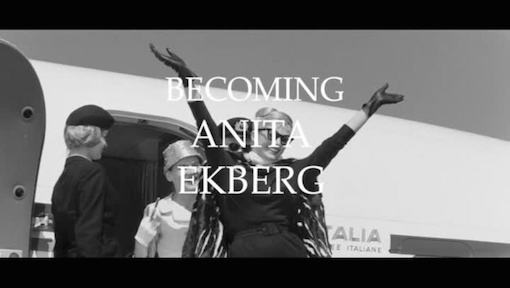
Becoming Anita Ekberg (Mark Rappaport, 2014) – an essay film (or film essay?) exploring the formation of Ekberg’s star image.


In the Distance_02

In the Distance (Florian Grolig, 2015) – an animated take on isolation in time of war.


Neither God_01

Ni Dios ni Santa María / Neither God nor Santa María (Helena Girón and Samuel M. Delgado, 2015) – witchery and voices from the past.


Night Without Distance_03

Noite sem distância / Night Without Distance (Lois Patiño, 2015) – the film that I was most eager to catch up with (regular readers will know that Patiño’s Costa da Morte was my favourite film last year). Another investigation of the Galician landscape, this time in the form of a smuggling operation across the Galicia-Portugal border and utilising a colour negative image.


Ulterior_01

Ulterior (Sabrina Muhate, 2014) – an essay film on death and life and our bodies in those states. Unnerving (although admittedly I am squeamish) but I think that this is a director with her own voice (and eye).

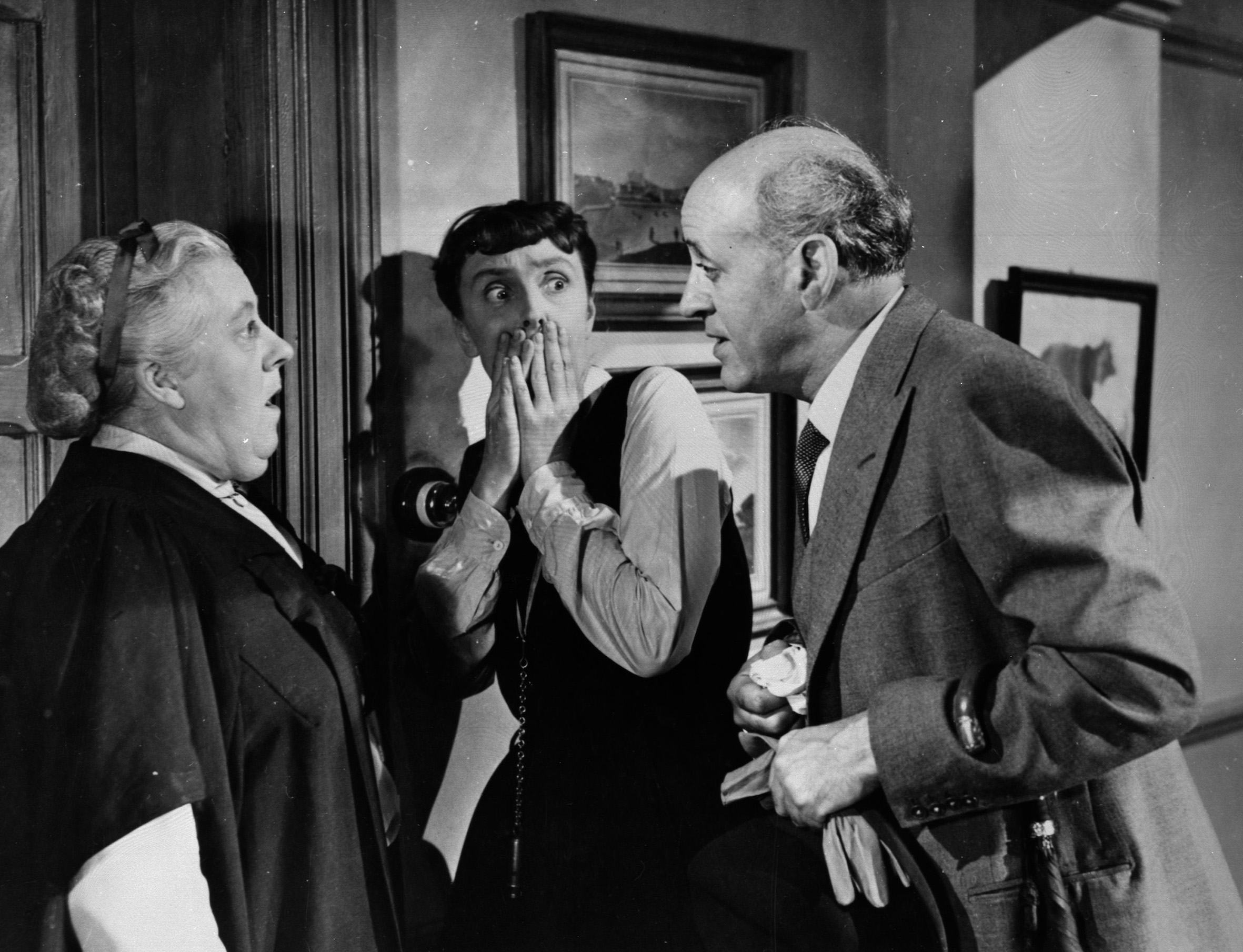
The Happiest Days of Your Life (Frank Launder, 1950)

HappiestDays_01

One of Launder and Gilliat’s funniest productions – and a British classic – The Happiest Days of Your Life has just been re-issued on DVD/Blu-ray in the UK. My review for Eye for Film is now online – here.

Fidelio, Alice’s Odyssey (Lucie Borleteau, 2014)

Fidelio

I saw this earlier in the year in a festival context, but the film is out in the UK today. My review is over at Eye for Filmhere.

Festival Report: Berwick Film and Media Arts Festival 2015

Berwick Logo

The ‘media arts’ aspect of Berwick marks it out as a bit different as a film festival (at least in terms of the film festivals I’ve been to so far) and the artists’ installations are placed in buildings / spaces of historical interest throughout the town – it’s a good excuse to explore the area, although I didn’t do as much wandering as last year. I’ve written a festival report for desistfilm focussed on the installations, short films and midlengthers – here. My overall favourite of the festival was Hacked Circuit (Deborah Stratman, 2014) but I’ll also be looking out for future films by Marko Grba Singh (Abdul & Hamza), Daphné Hérétakis (Archipels, granites dénudés), and Anna Sofie Hartmann (Limbo). My preview post on the festival now has the links to the films I reviewed.