Intermission

intermission

As mentioned in my previous post, I’m taking a break from blogging at the start of 2017. This is partly because there are some courses I’d like to do (and beyond my job I only seem to be able to concentrate on one thing at a time) – the courses are self-paced and involve subjects that are completely new to me, so I’m not sure how long they will take to complete.

But I’ve also lost interest in writing about films. I’ve just written about the personal and political ups and downs of the past year – and I have no doubt that those things have impacted on my general mood – but during 2016 I also packed away (or binned) a lot of research materials, notes, magazines and books relating to my older research interests because I felt that I had definitely come to the end of something in that regard. I need to put the blog to one side for a while in order to think about / do other things and reorient myself.

Setting a time scale only ever creates a rod for my own back, but it’s unlikely that I’ll be back on here before the summer. As I also mentioned in my end of year round-up, I will be reducing the amount of time I spend on Twitter, but I’m not intending to leave the platform altogether (I am also contactable via the details in the sidebar). Hasta luego…

My 2016 in review: films during a wearisome year

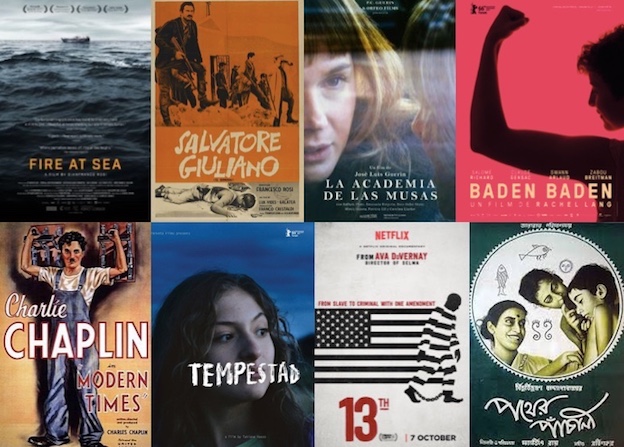
selected posters for my favourite films of 2016

This isn’t the normal introduction to my end of year cinematic round-up posts. I decided that to only write about films at the end of this particular year would represent an omission of some sort because my 2016 contained comparatively little cinema. I don’t subscribe to the current ‘worst year ever!!!’ hyperbole (on a personal level, this year falls way short of the nightmare that 2013 was for me) but it has been a wearisome and dispiriting twelve months, and something of a grind to get through. What is perhaps different about this year is that I don’t remember a time when so many people of my acquaintance (online and IRL) have collectively been brought low by the unfolding (inter)national dramas (e.g. the campaigns and results of the EU Referendum and US elections, nationalism and the Right on the rise seemingly everywhere, and the disparate voices of the Left finding fault with each other rather than seeking common cause). You would think that a sense of shared experience (or shared horror) would in some way be comforting, but I haven’t really found that to be the case (apart from knowing that if I am part of a social/political minority, it is still a sizeable one).
Social media can be a point of connection, news source, and method of organisation but it also amplifies misery to a sometimes overwhelming degree, wilfully misinforms, and acts as an echo chamber that presents a partial reality. Maybe you can counteract those limitations if you are aware of them, but I’m not sure. Feeling exhausted from the cycles of exaggerated outrage, incoherent anger and despair (and that was just me), I took an extended break from Twitter in the summer and felt better for it; more able to marshal my own thoughts and feel that I was constructively educating myself in subjects that I didn’t know enough about (I recommend this book as a starting point for understanding what’s going on in the UK, and these articles by Will Davies and Gary Younge are the best analysis I read in the aftermath of the referendum result). I didn’t manage to find an alternative source of news that was sufficiently as wide-ranging as Twitter can be, so that’s something I’ll still be looking for in 2017.
Several people in my Twitter timeline – in both June and November – said that they had woken up to find that their country wasn’t what they thought it was. But as those articles by Davies and Younge make clear, this wasn’t an overnight change (and for some people there wasn’t a change at all; they already knew what was there from lived experience) – the political fallout that we are living through was years (if not decades) in the making. The 2015 UK election result was recent evidence that a significant number of people are willing to ignore the damage done to the vulnerable in our society by a petty-minded and intellectually-stunted political class, just so long as it doesn’t impinge on their own standard of living. If a positive can be found in the events of this year, it is that injustice and inequality were made visible in a way that forced more people to look at and acknowledge what is happening…although a lot commentators have failed to change their respective scripts, and so are now overtly out of sync with what we’re watching. The challenge ahead will be to keep looking and not avert your eyes.
At an individual level, my year began with rumours of job cuts where I work. Sure enough, job cuts were eventually announced in May. I kept my job (my team was reduced and our morale generally depleted) but it doesn’t feel particularly secure, and I can only see further cuts on the horizon.
I stopped writing for other places in May. Partly because I wanted to concentrate on training opportunities that might improve my employment prospects, but also because in all honesty I could no longer see the point in continuing to write unpaid anywhere other than my own blog. The impetus for writing elsewhere was that my original blog only covered Spanish cinema and I wanted to explore a broader spectrum of films – I can now do that here. But it also comes down to how I should spend my time and money. If you can’t offset travel / accommodation costs for film festivals against being paid for what you write, you are effectively paying to work (and in my case doing so either in my ‘free’ time or on annual leave from my actual job – holidays that involve deadlines aren’t a proper break, and the resulting fatigue feels like a one-way ticket to mediocrity in all forms of work). Having used up my existing savings in relation to festivals in 2014 and 2015 – and taking into account the level of precarity that exists in relation to my job – I can’t sensibly afford to do that anymore. I attended the AV Festival in my home city in March, but apart from that my only film festival experience of 2016 was a daytrip to Leeds to catch Oliver Laxe’s Mimosas when it screened at LIFF in November. I’d like to go to at least one festival in 2017, but it will be in the capacity of leisure if I do so (and probably a daytrip).
All of this – the personal and the political – brought my mood down, and in turn (probably) led to a certain lack of enthusiasm for cinemagoing…although it should be noted that other factors include my continuing frustration with the programming at my local independent cinema and a couple of negative encounters with obnoxious audience members in the first part of the year. At the point of writing this (23rd Dec), I’ve seen 105 films this year (34 of which were shorts – short films are what I’ve most missed from not attending festivals) and only 9 of them in a cinema. In contrast, I saw 312 films (141 features and 171 shorts) in 2015 – that’s quite a drop off, and an indication of my general disinclination to watch or write about film in the second half of this year. On the upside, I’ve read a lot more books and have generally found other things to occupy my time and keep my brain active (mainly involving maths and computers, which is not something I thought I’d ever write)! I’m intending to take a substantial break from blogging at the start of 2017 because there are some more courses I’d like to do, but I also need to think through what I want to do here, and watch some films just for the sake of enjoyment. There are a lot of films I’d like to catch up with – the most obvious 2016 misses at the moment are Son of Saul and I, Daniel Blake (I didn’t feel up to watching them when they were on release) – and it’s quite a nice task to create a rental list using everyone’s end of year round-ups.
But anyway (finally), on to my favourite films of the year – divided into ‘new’ (films from 2015 or 2016 and watched for the first time this year) and ‘old’ (anything pre-2015). I haven’t done a top 10 because it felt a bit like making up the numbers – so I’ve got eight in the first category and five in the latter, with some additional honourable mentions. For the new films I’m generally allowing other people’s words to stand in for my own (I haven’t written any notes while watching films this year) by linking to pieces written by people whose writing I admire and articles that gave me insight into the film in question.

New:
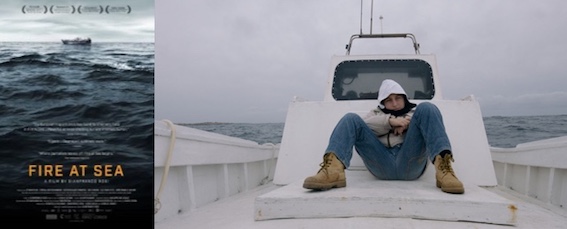
poster and still image from Gianfranco Rosi's Fire at Sea1. Fuocoammare / Fire at Sea (Gianfranco Rosi, 2016)
A timely film about the humanitarian disaster on Europe’s doorstep in the waters around the island of Lampedusa, 150 miles south of Sicily. The film initially follows 12 year old Samuele (probably the most affable presence I’ve seen onscreen this year) around the island as he makes slingshots and listens to seafaring tales from his father. I was bracing myself for some kind of manufactured ‘meet-cute’ between the boy and rescued migrants but, as Rosi makes clear in this interview, part of the point being made is that these groups of people share the geographic space but occupy completely different worlds – so although a doctor acts as a bridge between the two communities, they do not overlap. The film roots itself in the island and then circles outwards, first with overheard distress calls, short sequences of rescue boats and helicopters scouring the sea, rescued people being checked over when they’re brought onto land, but getting ever closer to the deaths on the waters. When we finally reach the inevitable tragedy (one example of many – on the day I’m writing, the number of people who have drowned trying to reach Europe in 2016 has passed 5,000) it is difficult to watch but necessary to witness. If a film can be described as ‘humane’, that is what Rosi has compassionately created.
Olaf Möller at Film Comment
Michael Pattison at Indiewire
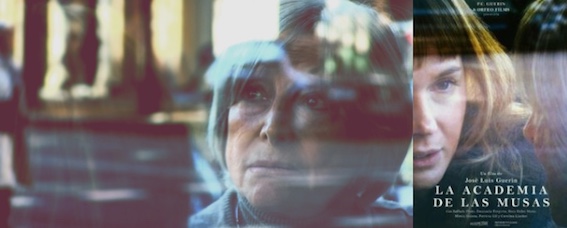
poster and image from José Luis Guerin's The Academy of Muses2. L’ accademia della muse / The Academy of Muses (José Luis Guerin, 2015)
As far as I know, Guerin’s surprisingly funny ‘pedagogic experience’ hasn’t screened in the UK at all – I was keeping an eye out for it appearing at a festival, but to no avail. I finally watched it on Filmin a couple of weeks ago, but I’ll now be keeping my fingers crossed for a DVD with optional English subs to be released (certainly I’d want subs before I attempt to write about it in any depth) – although in some ways it felt appropriate to be watching a film that plays with language and meaning without the benefit of my mother tongue.
Cristina Álvarez López at Fandor
Antonio M. Arenas’s interview with Guerin at Magnolia
Nicolás Carrasco at desistfilm
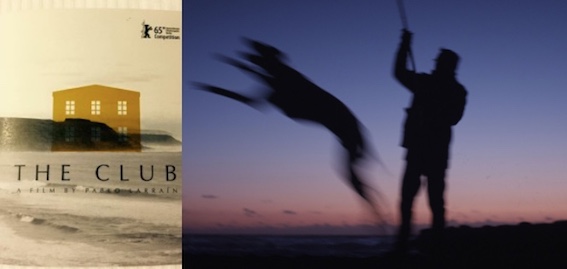
poster and image from Pablo Larraín's The Club3. The Club (Pablo Larraín, 2016)
I have already made my admiration for Larraín’s work (and Alfredo Castro) clear. Expiation isn’t quite the right word that I’m searching for in relation to this drama because I’m not sure that atonement is pursued (self-interest dictates the actions of those who should be seeking it), but Larraín again exposes the ugly underside of Chilean society to shine a light on historical abuses of power that cannot simply be left in the past – they must be acknowledged because the repercussions reverberate into the present (the film’s gauzy, crepuscular light suggests that time may be running out – or perhaps that the old order are in their dying days). The Club also makes manifest the fact that dogs can make reprehensible people relatable. Larraín uses the relationship between Castro’s Father Vidal and the greyhound to foreground man’s inherent animality, and to highlight the absence of a certain level of humanity in this specific group of people. The contrast between what they acknowledge in relation to the dog (“Do you forgive me?” “No, motherfucker!”) and their lack of empathy for the abused man/child who appears at their door, is an illustration of their collective mindset and state of denial. A film that I will no doubt return to – but in the meantime, I’m looking forward to Neruda (Pablo Larraín, 2016), due for release in the UK in 2017.
Mónica Delgado at desistfilm
Nick Pinkerton at ArtForum

image and poster from Ava duVernay's documentary 13th4. 13th (Ava DuVernay, 2016)
A cogently-argued indictment of institutionalised racism within America’s criminal justice system. The title refers to the 13th Amendment in the US Constitution – which states that “Neither slavery nor involuntary servitude, except as a punishment for crime whereof the party shall have been duly convicted, shall exist within the United States, or any place subject to their jurisdiction.” – and DuVernay argues that slavery has effectively been maintained via that loophole of punishment, and turned into a profitable business for private companies. The film is impressively detailed in the breadth and depth of issues that it covers – rather than focus on only a few aspects of a complex set of interconnecting issues, DuVernay instead skilfully weaves everything together (prisons, courts, sentencing, legislation, government, private influence and vested interests) to create a multi-faceted overview, and tightly argued case, that alternately makes your blood boil or run cold.
Ashley Clark’s interview with DuVernay in Film Comment

poster and image from Denis Villeneuve's Arrival5. Arrival (Denis Villeneuve, 2016)
The only film in this selection that I saw in the cinema – two of Villeneuve’s films were in my list last year, so I made an effort to see this one on the big screen. I don’t want to post spoilers as it is still in UK cinemas, so I’ll just say that a significant aspect of the last part of the film didn’t work for me but I’m also keen to see it again because (as with other Villeneuve films) where the film ends casts earlier events in a different light (it’s possible that a rewatch could resolve my problem with the film…or unravel the film entirely). It was nice to see a capable and intelligent female lead…and I badly needed a hit of cinematic wonder.
I’d advise against reading the articles below until you’ve seen the film.
David Bordwell on an aspect that I don’t feel able to name before you’ve seen the film
David Cairns at Shadowplay
Margaret Rhodes on how the filmmakers designed the alien alphabet

an image and poster from the documentary Tempestad6. Tempestad (Tatiana Huezo, 2016)
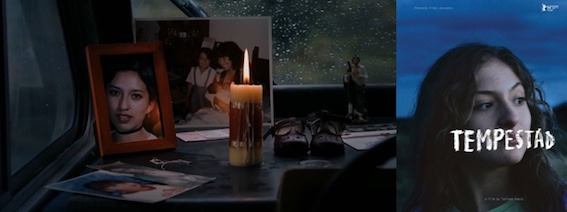
The VOD platform Festival Scope has two sites: one for film professionals (programmers, reviewers, filmmakers, and so on); the other is open to the general public and is increasingly being used to host selections from recent film festivals (a film can cost a couple of euros to watch, or sometimes it’s free but there are a limited ‘tickets’). I watched Tempestad on the latter when it hosted a number of films from Morelia International Film Festival because I had read about it in Neil Young’s article on Mexican female documentary filmmakers (see below), but also because it tangentially related to a book I had recently read, The Beast: Riding the Rails and Dodging Narcos on the Migrant Trail by Óscar Martínez (half price until the end of the year via that link). Martínez’s book is ostensibly about the migrants trying to make it to the US but that necessitates that he looks at violence in Mexico and the complicity between the authorities and the cartels. Huezo’s film comprises of testimony by two Mexican women, Miriam Carbajal (unseen) and Adela Alvarado, who have experienced the personally devastating consequences of that complicity in different ways: Miriam is a former customs official who was thrown into prison (controlled top to bottom by a cartel) when the authorities needed a very public scapegoat for a scandal (which she had nothing to do with); Adela is a circus performer, a nomad without a fixed home due to threats received (from both sides of the law) because of her persistence in searching for her daughter, who disappeared on her way to school a decade earlier. Powerless against the State and its agents, and caught within circumstances almost too nightmarish to comprehend, these two women regain some of their personal agency by telling Huezo their stories in their own words, with dignity and no small amount of courage. Huezo entwines word, image and a multi-layered soundscape into a haunting film.
Neil Young in Sight & Sound on the rise of female documentary makers in Mexico
The film’s website (includes a subtitled trailer)
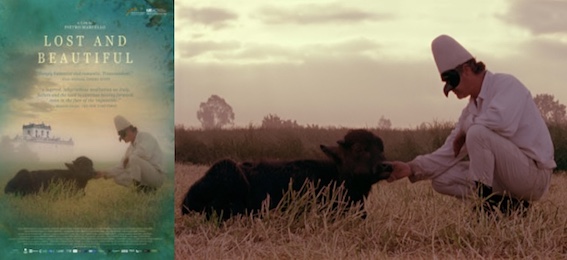
poster and an image from Bella e perduta / Lost and Beautiful7. Bella e perduta / Lost and Beautiful (Pietro Marcello, 2015)
Marcello’s film walks a line between fable and (unconventional) documentary, with a personable buffalo calf as one of its leads and a folkloric character as another, resulting in what Jonathan Romney has recently described as ‘a UFO of a film—in this case, an Unidentified Folkloric Object’.
Jonathan Romney in Film Comment

Rachel Lang's Baden Baden8. Baden Baden (Rachel Lang, 2016)
MUBI UK screened Lang’s feature debut alongside two of her earlier shorts featuring the same character, Ana (played in all instances by Salomé Richard). It was interesting to watch these close together as they form a kind of speeded up cinematic evolution of both filmmaker and actress. Ana’s sense of purpose (or lack thereof) changes with each film – it’s possible that these are different iterations of the character rather than an intended character arc across several films, but it’s also possible that these changes are a manifestation of Ana’s unformed self (she doesn’t know who she is yet – or what she wants to do with her life). It’s unusual to see a female slacker (several articles reference Frances Ha, but I still haven’t seen that (yes, I know), so can’t make that connection myself), or a female character granted the space to define herself, however unsuccessfully. It’s not actually the type of film I usually have much urge to see but I found this one charming and surprisingly moving – and Salomé Richard is a face to watch for in the future.

Honourable mentions (alphabetical): Embrace of the Serpent (Ciro Guerra, 2016) [review], Midnight Special (Jeff Nichols, 2016), Mimosas (Oliver Laxe, 2016), O Futebol (Sergio Oksman, 2015) [review], The Pearl Button (Patricio Guzmán, 2016), The Royal Road (Jenni Olsen, 2015) [VOD], Shaun the Sheep (Mark Burton and Richard Starzak, 2015), Spotlight (Tom McCarthy, 2015).

Old:

I reactivated my subscription to Lovefilm this year and have been more successful than in the past at watching the DVDs when they’re sent to me (rather than leaving them unopened for several weeks) – there are still a lot of older films that aren’t available via streaming, and a rental service has the advantage of reducing my impulse buys when I read about a film, actor, or director and want to watch them/their work. Overall the majority of the films I watched in 2016 were not from recent years – restarting the rental account allowed me to explore the work of filmmakers unfamiliar to me without committing to pricey boxsets.

an image from Francesco Rosi's Salvatore Giuliano1. Salvatore Giuliano (Francesco Rosi, 1961)
I’m not entirely sure how I came to have a Francesco Rosi mini-season. It was possibly prompted by the re-release of his Tre Fratelli / Three Brothers (1981), which reminded me that I had Salvatore Giuliano and Le mani sulla città / Hands Over the City (1963) sitting unwatched on my shelf. I followed on with Cadaveri Eccellenti / Illustrious Corpses (1975), had to abandon an atrociously-dubbed version of Lucky Luciano (1973), and have yet to watch Cristo se è fermato a Eboli / Christ Stopped at Eboli (1978). My main frustration now is how few of his 20 films are available for home viewing in any format, and how even fewer are available with English subtitles (this seems broadly to be the case with Italian cinema in the UK – Rosi led me down a rabbit hole to Gian Maria Volontè and Elio Petri, and similarly very few of their films are available with subtitles). Salvatore Giuliano is my favourite of Rosi’s films so far and it wasn’t a surprise to find that Martin Scorsese rates it among his favourite films because he was who came to mind while I was watching it. They share an ability (for me, at least) to cause a sense of exhilaration through the sheer élan of their filmmaking – camera movement, editing, and sound are combined so that a visceral thrill comes from the form and style. Likewise both directors are interested in depicting the power dynamics within enclosed groups of men, but Rosi’s films also stand as critical portraits and indictments of aspects of Italian society. There were moments during Salvatore Giuliano where I realised that I was grinning from the enjoyment of watching something so well crafted. Henceforth I will be on a mission to locate more of Rosi’s films.

an image of Chaplin in Modern Times2. Modern Times (Charlie Chaplin, 1936)
Cough – my first Chaplin feature – cough. I’m embarrassed that it has taken me so long to watch a Chaplin film in its entirety (I’ve definitely seen some of the shorts and various clips/sequences) but I’ll admit that I wasn’t expecting it to be so funny or so…modern. I am in the process of working my way through his features via Lovefilm.
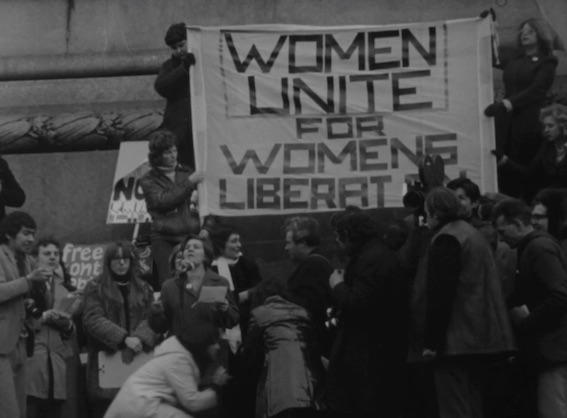
an image from Nightcleaners3. Nightcleaners (The Berwick Street Collective, 1975)
My review of the film from the screening at the AV Festival in March.
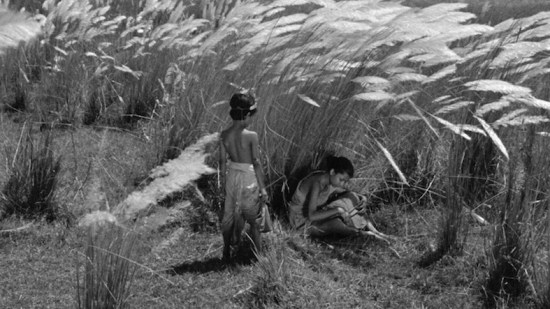
an image from the first of Satyajit Ray's Apu trilogy, Pather Panchali4. Pather Panchali (Satyajit Ray, 1955)
Yet another admission of a chasm in my cinematic experience – I had never seen a Satyajit Ray film. The Apu Trilogy (which consists of Pather Panchali, Aparajito, and The World of Apu) is OOP in the UK but I’ve realised that when Amazon bought out Lovefilm they must have bought their back catalogue (which way back at the dawn of time used to belong to MovieMail when it was a rental business – I used to rent VHS from them through the post!), with the result that you can rent some titles that currently aren’t available to buy – including these three films. It is hard to separate them but I found something especially magical about this one – and I’m a sucker for depictions of sibling relations between brothers and sisters (a dynamic mixture of love and irritation).

an image of multiple cast members in Snowpiercer5. Snowpiercer (Bong Joon-Ho, 2013)
“Know your place. Keep your place. Be a shoe.” A dystopian vision of the future in the aftermath of a climate-change experiment gone wrong, with the best and worst of humanity stuck on the same train. Depressingly plausible – as anyone who has travelled on British trains can confirm – but the violence is quite cathartic.

Honourable mentions (alphabetical – links take you to VOD versions where available): Daybreak Express (D.A. Pennebaker, 1953), The Friends of Eddie Coyle (Peter Yates, 1973), Güeros (Alonso Ruizpalacios, 2014), Indagine su un cittadino al di sopra di ogni sospetto / Investigation of a Citizen Above Suspicion (Elio Petri, 1970), Land of Promise (Paul Rotha, 1946) [review], Spare Time (Humphrey Jennings, 1939) [review], Los Sures (Diego Echeverria, 1984), Utopias (Marc Karlin, 1989) [review].
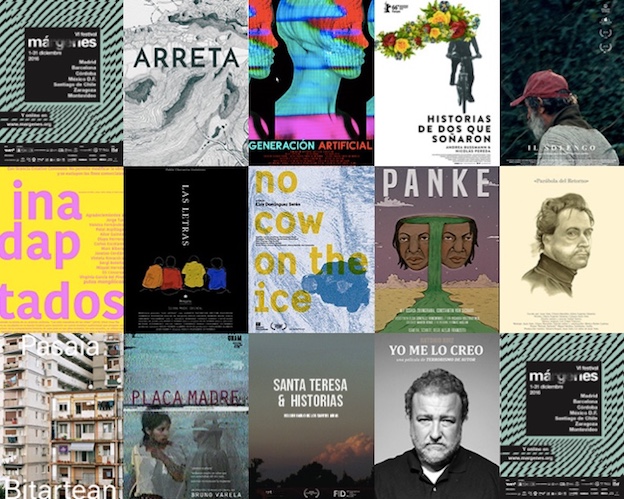
6th Festival Márgenes: free to view online, 11th – 31st December

6th-margenes-festival

I have previously written about the 4th and 5th editions of this Spanish online festival. Specifically dedicated to films – from the Iberian Peninsula (Spain and Portugal) and Ibero-America (Spanish and Portuguese-speaking Latin American countries) – whose form, style, or duration mean that they will struggle to access the normal distribution routes or obtain a commercial release, Márgenes initially takes place in key cities in Spain, Mexico, Chile and Uruguay at the start of December, before moving online during the second half of the month. Documentaries and experimental films tend to dominate the selection.
The online side of the festival makes the films free to view. Sometimes there are rights restrictions on specific titles in certain countries – at the moment Generación Artificial and Santa Teresa y otras historias aren’t visible to me, but I don’t know if that’s a rights issue or just a glitch on the website. Films that aren’t in Spanish tend to have Spanish subtitles, but in past years the majority of the Spanish-language films have had English subtitles. The subtitles aren’t listed on the website – I’ve put a * next to the trailer links below where the festival has used a trailer with English subtitles, which is often a good indication of there being subs on the film as well [UPDATE: this hasn’t been a good indicator this time around]. But given that the films are free to view, you aren’t going to lose anything by starting a film to see whether subtitles appear. I never manage to watch everything, but I will update this post to indicate the presence of subtitles on any films I watch [UPDATE: I’ve watched two and looked at a third – I’ve added the subtitle info below].
The previous editions I’ve explored have revealed gems such as África 815 (Pilar Monsell, 2014), El gran vuelo / The Great Flight (Carolina Astudillo, 2014), and La sombra (Javier Olivera, 2015) (the latter was my favourite in last year’s festival). I can recommend No Cow on the Ice (I reviewed it earlier this year) and personally will be aiming to at least catch Pasaia bitartean, Santa Teresa y otras historias (if it’s available), and Las letras (on the basis that I’ve read positive things about them in relation to other film festivals). The festival announced its prizes yesterday – I’ve marked the winners below as well.
This is the line-up of titles in the 2016 official selection (clicking on the title will take you to the streaming page for that film):

> Arreta (Raquel Marques and María Zafra, 2016, Spain – 60 min) *trailer
> Generación Artificial / Artificial Generation (Federico Pintos, 2015, Argentina – 62 min) *trailer
> Historias de dos que soñaron / Tales of Two Who Dreamt (Andrea Bussmann and Nicolás Pereda, 2016, Mexico/Canada – 82 min) *trailer
> CAMIRA PRIZE: Il solengo (Alessio Rigo de Righi and Matteo Zoppis, 2015, Italy/Argentina – 66 min) trailer
> Inadaptados (Kikol Grau, 2015, Spain – 41 min)
> BEST FILM: Las letras / The Letters (Pablo Chavarría Gutiérrez, 2015, Mexico – 77 min) [with English subtitles] trailer
> SPECIAL MENTION BY THE JURY: No Cow on the Ice (Eloy Domínguez Serén, 2015, Spain – 63 min) *trailer
> Panke (Alejo Franzetti, 2016, Argentina/Germany/Burkina Faso – 46 min) *trailer
> NUMAX EXHIBITION PRIZE: Parábola del retorno (Juan Soto, 2016, Colombia – 41 min) trailer
> Pasaia bitartean (Irati Gorostidi, 2016, Spain – 51 min) [Castilian Spanish subs] *trailer
> Placa Madre / Motherboard (Bruno Varela, 2016, Mexico/Bolivia – 54 min) trailer
> Santa Teresa y otras historias / Saint Teresa and Other Stories (Nelson Carlo de los Santos Arias, 2015, Dominican Republic/USA/Mexico – 65 min) [no subs] *trailer
> Yo me lo creo (Terrorismo de Autor, 2016, Spain – 40 min) trailer

The Márgenes Festival 2016 also includes a retrospective of the work of Lluís Escartín, titled ‘no tengo nada que decir, prefiero escuchar. 30 años documentando lo invisible‘ [I don’t have anything to say, I prefer to listen: 30 years documenting the invisible], and a cycle dedicated to Chilean director José Luis Torres Leiva, ‘Un lugar en el mundo‘ [A place in the world] – they are likewise free to view online until 31st December.

Montaña en sombra / Mountain in Shadow (Lois Patiño, 2012)

Mountain in shadow from lois patiño on Vimeo.

One of my favourite short films from the last few years has been put up on Vimeo by its director. I saw Lois Patiño’s Montaña en sombra / Mountain in Shadow on the massive IMAX screen at the Bradford International Film Festival in 2014 where it accompanied Patiño’s feature debut, Costa da Morte / Coast of Death – in my 5-star review of the latter, I mention the short in the last paragraph. I feel privileged to have seen it in an ideal viewing environment originally, but it’s also nice to have the opportunity to watch it again (even on a small screen).


Stella Cadente (Lluís Miñarro, 2014)

stella-cadente2

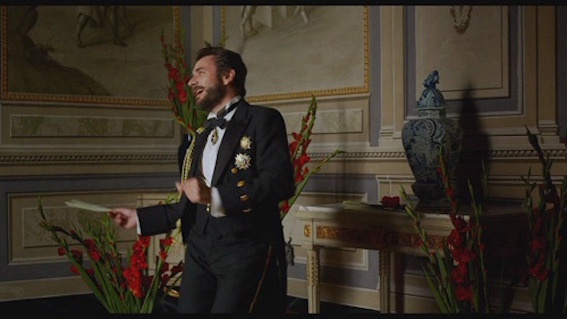
Lluís Miñarro’s opulent and riotous Stella Cadente (which means ‘falling star’) is being released on DVD in the UK next week courtesy of Second Run.

On the surface an account of the short reign of King Amadeo I of Spain in the early 1870s – although this is a film where surfaces can be deceptive – Stella Cadente also functions as a metaphor for contemporary Spain and its ongoing state of crisis. But this is far from being a fossilised heritage drama – the afore-mentioned deceptive surfaces are manifested via a state of Wonderland-like limbo within the walls of the palace, and Miñarro laces the film with perverse humour and surreal juxtapositions (if I recall correctly, Àlex Brendemühl’s Amadeo is dancing to the anachronistic sound of 1970s French chanson in the above image). I was rather bemused by the ‘busy-ness’ of the film when I saw it at EIFF in 2014 (my Eye for Film review can be found here) but liked it sufficiently to import the Spanish DVD the following year – its chief pleasures are sparky performances by Brendemühl and Bárbara Lennie (who plays Amadeo’s wife, María Victoria), and the sense of reality being challenged by illusion in the layered theatricality created by Miñarro (for me, this confusion of reality versus illusion – in combination with the royal milieu – brought Calderón de la Barca’s La vida es sueño / Life is a Dream to mind, although the director didn’t seem overly keen on the comparison when I asked about it during the Q&A). As I noted in my review, the film also includes my favourite subtitle of that year: “Set these rabbits free!”

Second Run’s presentation also includes one of Miñarro’s documentaries, Familystrip (2009) – while his parents have their portrait painted, the director converses with them about their lives, respective childhoods, raising a family in post-War Spain, and the social changes undergone by the country during their lifetimes. It combines oral history with a deeply affectionate cine-portrait of his family. You can buy the DVD directly from Second Run (it is also available from other retailers).

10,000 Km (Carlos Marques-Marcet, 2014)

10000km

Carlos Marques-Marcet’s feature debut, 10,000 Km (also known as Long Distance), won him the ‘Best New Director’ award at the Goyas in 2015 – the film is available to view on Mubi UK for the next month. The use of social media and new technology onscreen is often cringeworthy but Marques-Marcet and co-writer Clara Roquet on the whole manage to utilise familiar forms of online interaction in a naturalistic way, and create an immersive experience – technology becomes both a point of connection and something that heightens different kinds of distance when a couple (Natalia Tena and David Verdaguer) try to maintain a relationship over the course of a year apart. The film is essentially a two-hander, and I wrote in my review from 2014 that:

Tena and Verdaguer make what could have been an inert series of monologues (we often see them as the other character would, meaning that they are talking direct to screen) into conversations with dramatic and emotional heft. […] That we see neither of them outside of their respective domestic spaces illustrates both the hermetically-sealed nature of Alex and Sergi’s relationship (they are each other’s world) and the limits of their interactions when they are so far apart. The time difference means that their communications are rarely spontaneous, instead becoming a rote series of appointments that make the lack of physical contact glaringly apparent – it is difficult to slow dance with a laptop (although they do try).

The rest of my review can be found at Eye for Film. Take advantage of the film’s appearance on Mubi because a) it’s a well-made romantic drama that is imbued with emotional veracity, and b) there is no UK DVD (although the Spanish DVD has optional English subtitles).

My Name Is Salt (Farida Pacha, 2013)

my_name_is_salt_sisyphus

The rather dry synopsis of ‘a documentary about salt production’ doesn’t really do justice to (or offer enticement to see) Farida Pacha’s documentary, which closely observes the rhythms and motions of one family on the salt marshes of Gujarat in India, following their routines during the eight months of the year that they spend cultivating and harvesting salt crystals before the annual monsoon season washes everything away. I like films that show the mechanics and processes of work / creation and this stark but beautiful film (a reflection of the landscape in which it takes place) was one of my favourites at the Edinburgh International Film Festival in 2014. By chance, I’ve just spotted that it is available to rent on BFI Player. My Eye for Film review from 2014 can be found here. You can also find further information on the film’s website.

El Movimiento / The Movement (Benjamín Naishtat, 2015)

El movimiento_04

A heads up: another film I saw in Gijón last year, El Movimiento, is currently available to watch on Mubi UK (films stay on that platform for 30 days) – here. After my original viewing last November (without subtitles), I wrote that:

Set in Argentina in 1835 (by weird coincidence the same year that Aferim! is set) in the aftermath of what the festival catalogue tells me was the emancipation war of the Provincias Unidas del Río de la Plata, a fratricidal conflict develops while the new administration settles in. Several armed groups are wandering the Pampa, looking for resources but each also claims to be the legitimate representative of El Movimiento. The leader of one of these groups, known simply as el Señor (Pablo Cedrón), presents himself with the language of idealism and the moral high ground but unleashes hideously violent acts via his henchmen. Shot in black and white, the film is visually very striking – the lighting is very high contrast (it mainly seemed to rely on light sources within the frame), casting jet-black shadows across the numerous close-ups of faces, and at times it looks almost like a painting. The soundtrack is also unusual given the era in which the film takes place because it includes electronic sounds (late in the film, a truck and a motorbike also cross the back of the frame) which build to a low rumbling threat – it becomes quite oppressive.

I re-watched it the other night (it’s only 70 minutes) and would recommend catching it while it’s on Mubi – the running time makes it unlikely to get a theatrical release in the UK. I’m glad that I caught up with it again. I have also found a video of a Q&A (in English) with writer-director Benjamín Naishtat at a screening in New York.


Review: Black (Adil El Arbi and Bilall Fallah, 2015)

Black

Out in the UK (cinemas and VOD) on 19th August, Black is a Romeo and Juliet-style tale of rival street gangs and immigrant communities in contemporary Belgium. I saw the film last year in Gijón and although I felt strongly (negative) about its depiction of sexual violence, it nonetheless has an undeniably strong sense of visual style and energy – its duo of Morrocan-Belgian directors demonstrate cinematic flair in abundance and an adept deployment of music – and two engaging performances from the non-professional leads, Aboubakr Bensaïhi and Martha Canga Antonio. My review from Gijón for Eye for Film:


Review: Queen of Earth (Alex Ross Perry, 2015)

Queen of Earth_poster

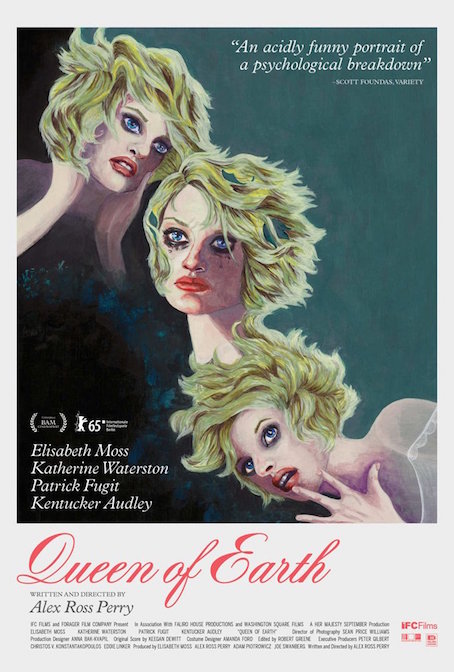
Queen of Earth was one of my favourite films last year (I saw it in April 2015 at the D’A Festival in Barcelona) and I’d been hoping that it would get UK distribution – as I said back in December, “this kind of film should be catnip to independent cinemas”. It is on limited release and VOD from today but if it’s not showing at a cinema near you (it isn’t showing anywhere near me), a Masters of Cinema dual format DVD/Blu-ray release will also be available from the 11th July. Prior to seeing Queen of Earth I was only familiar with Elisabeth Moss via Jane Campion’s Top of the Lake (I haven’t seen Mad Men), but between those two performances she marks herself out as someone whose work should be followed. She and Katherine Waterston (also excellent) clearly relished the opportunity to be put through the emotional wringer on camera – both deliver nuanced performances in a psychologically astute and darkly funny look at the deep bonds of female friendship and the damage that can be wrought by those closest to you. My 2015 Eye for Film review:

Nobody Knows Anybody will be relatively quiet for the rest of the summer. Back in May – when I decided that I would change my approach to the Carlos Saura Challenge – I made reference to the upheaval that my place of work undergoes like clockwork each summer. Three days later I discovered that this year the upheaval would be more unsettling than I had anticipated. I am one of the lucky ones because my job is intact – although my team has been reduced by 20% through existing vacancies being written off and some of my colleagues reducing their hours – but there are a lot of ongoing job cuts here and morale is low. Between that and the spectacle of my country deciding to flush itself down the toilet in slow motion, I’m not much in the mood for watching films at the moment – or writing about them.

Overlord (Stuart Cooper, 1975)

Overlord_21

I wrote about Overlord almost two years ago for Big Picture Magazine in the context of their ‘Lost Classic’ strand – the film had recently been released on Blu-ray by Criterion and was therefore generating some buzz, although I had been unaware of the film or its growing reputation until I watched it on Mubi and subsequently went looking for more information. Anyway, my short piece can be found here:

The reason that I’m posting the link now is that Criterion have just released the film on their new UK Blu-ray line (a DVD (not Criterion) is also available – I bought one back in 2014), which came to my attention via this detailed article by Paul Duane at Mostly Film. Stuart Cooper’s 1969 short film, A Test of Violence – mentioned in that article – is on Youtube.

Reprint: Tren de sombras / Train of Shadows (José Luis Guerin, 1997)

Tren de sombras_1

I originally wrote about Guerin’s Tren de sombras / Train of Shadows on the old blog in February 2014 (Update, August 2017: where I have reprinted something here, I have decided to remove the contents of the original on the old blog and instead leave a link there to the new site (it doesn’t make much sense to have the pieces appear in two places)). I am substantially revising that post for this entry in my Reprint series because I have partially rewatched the film this evening (I watched the opening 10 minutes or so and then the last 40 minutes) and subsequently reconsidered at least one element of my earlier piece.

I originally watched Guerin’s film because it had been mentioned multiple times in relation to El Futuro / The Future (Luis López Carrasco, 2013), in Spanish coverage at least, and having not seen the film I wasn’t sure what was being referenced. But it could also stand as a companion piece with Aita (José María de Orbe, 2010) – which I watched for the first time shortly before watching Tren de sombras – focusing as it does on a combination of (apparent) archival footage and a grand house. The connection to El Futuro is the recreation of an era, not simply representing the past but constructing a film that looks as if it was made in the era depicted. Guerin’s film is almost wordless and the only contextualisation for what we see are the opening intertitles explaining that in 1930, amateur filmmaker Gérard Fleury made a home movie in the grounds of his house, a film that would be his last as he died a few months later in mysterious circumstances while filming on a nearby lake. The intertitles also tell us that film had been in such a fragile condition that it was in no state be projected but that it has now been restored.

Back in 2014, I thought that I had misunderstood the French intertitles (there were no English subtitles on the format that I watched) precisely because I initially thought that they had managed to reassemble the 1930s family film when in actual fact Guerin recreated it (something that becomes apparent as the film progresses – so after a certain point I thought that I had confused ‘restored’ and ‘recreated’). As it happens, my French was better than I thought and the opening intertitles are a deliberate piece of misdirection on Guerin’s part. Conceived when the centenary of cinema was approaching, Tren de sombras was a manifestation of Guerin’s desire to explore the origins of filmmaking and a kind of cinematic immersion. The film’s title is a reference to a line from Maxim Gorky’s essay ‘The Kingdom of Shadows’ about his experience of watching moving pictures (by the Lumière brothers) for the first time in 1896 (there is an English translation of that text, here). It might be more accurate to say that Guerin created – as opposed to recreated (because I’m not sure that there is any Fleury family film other than the one shot by Guerin) – a realistic representation of 1930s filmmaking. It’s a testament to the quality of this reconstruction that it is perfectly believable as a 1930s film – indeed a number of reviewers have taken it at face value and refer to the film as making use of ‘found footage’.
The film opens with this 20 minute ‘home movie’, showing Fleury’s extended family at play in the grounds of their home and the surrounding countryside in the summer of 1930. We then switch to ‘the present’ and the nearby town (now in colour), before moving into the grounds of the Fleury home and then the house itself (the interior of which is not seen in the 1930s segment). It is at this point that Guerin’s film foreshadows aspects of Aita; although this house is evidently inhabited, the attention to textures, patterns, reflections – as well as the use of doorways and mirrors to frame our view and the ‘layering’ of the image (by which I mean that the depth of field alters, allowing us deeper into an image) – reminded me of the later film. This sequence is extraordinarily lush with rich colours and patterns in the interior of the house and verdant greenery outside – in conjunction with the music on the soundtrack, it put me in mind of the kind of magical otherness that I associate with Powell and Pressburger productions. The detailed layering and framing hints at what is yet to come, as Guerin and his camera turn detective and revisit the 1930s footage to peel away its layers and reveal secrets within.

Tren de sombras_2

In almost a cross between Antonioni’s Blow-Up (1966) and the kind of analysis that the Zapruder film has been subjected to, Guerin slows, replays, freeze frames, and enlarges different sequences of the film to follow the sightlines of those on camera. This gives new emphasis to the play of shadow and light at the back of the image and brings hidden connections and relationships to the surface. Guerin effectively plays with the language and form of cinema on the screen. The film is broken down to its constituent parts and then put back together with the grain of the image acting as a ‘witness’ to the supposed veracity of what we’re presented with, when in fact it is another layer of the show constructed by the director (the film was degraded by hand during the post-production and editing stages). The sequences that ‘reveal’ the most (shadows of simmering passions and traces of a possible love triangle) are then performed in front of us anew in colour, which is quite jarring. The use of colour in the recreation is the point at which the fakery seems apparent – I am slightly confused that those reviewers who take the 1930s footage as genuine don’t notice that it is the same actors (namely Juliette Gautier and Ivon Orvain) who appear in colour, although with some deliberately exaggerated elements of costume and make-up. In the colour section the camera moves between the different fields of view within the image, illustrating the layering of the image (and again demonstrating the importance of depth of field). As with Aita, at the end of the film I felt like I had just watched a magic show.

Tren de sombras_3

There is a French boxset (this one) containing Guerin’s Innisfree (1990), Tren de sombras, and Unos fotos en la cuidad de Sylvia / Some Photos in the City of Sylvia (2007) with optional English subtitles on all of the films.